
Acerca da atuação do psicólogo forense em contextos de violência e vulnerabilidade, julgue os itens subsecutivos.
Conforme o Estatuto do Idoso, as medidas protetivas são aplicáveis nas situações em que exista a constatação de violência física, sendo papel do psicólogo diagnosticar e exigir medidas protetivas ao Ministério Público no que concerne às situações de violência direcionada a essa população, como o abuso psicológico ou material.
Julgue os itens seguintes a respeito da IN n.o 4 MPOG/SLTI e da Resolução CNJ n.º 182.
De acordo com a Resolução CNJ n.º 182, o planejamento das contratações de solução de TI e comunicação incluirá as seguintes fases: análise de viabilidade da contratação, análise dos aspectos técnicos da solução e análise dos aspectos administrativos da contratação.
No que se refere à organização de arquivos e métodos de acesso a bancos de dados, julgue os próximos itens.
O acesso direto a registros será eficiente ao se usar funções hash, visto que essas funções garantem uma relação unívoca entre o registro e a sua localização física.
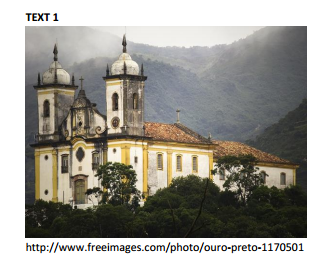
Mining tourism in Ouro Preto
Ouro Preto is surrounded by a rich and varied natural
environment with waterfalls, hiking trails and native vegetation
partially protected as state parks. Parts of these resources are
used for tourism. Paradoxically, this ecosystem contrasts with the
human occupation of the region that produced, after centuries, a
rich history and a cultural connection to mining, its oldest
economic activity which triggered occupation. The region has an
unlimited potential for tourism, especially in specific segments
such as mining heritage tourism, in association or not with the
existing ecotourism market. In fact, in Ouro Preto, tourism,
history, geology and mining are often hard to distinguish; such is
the inter-relationship between these segments.
For centuries, a major problem of mining has been the reuse of
the affected areas. Modern mining projects proposed solutions to
this problem right from the initial stages of operation, which did
not happen until recently. As a result, most quarries and other
old mining areas that do not have an appropriate destination
represent serious environmental problems. Mining tourism
utilizing exhausted mines is a source of employment and income.
Tourism activities may even contribute to the recovery of
degraded areas in various ways, such as reforestation for leisure
purposes, or their transformation into history museums where
aspects of local mining are interpreted.
Minas Gerais, and particularly Ouro Preto, provides the strong
and rich cultural and historical content needed for the
transformation of mining remnants into attractive tourism
products, especially when combined with the existing cultural
tourism of the region. Although mining tourism is explored in
various parts of the world in extremely different social, economic,
cultural and natural contexts, in Brazil it is still not a strategy
readily adopted as an alternative for areas affected by mining
activities.
(Lohmann, G. M.; Flecha, A. C.; Knupp, M. E. C. G.; Liccardo, A.
(2011). Mining tourism in Ouro Preto, Brazil: opportunities and
challenges. In: M. V. Conlin; L. Jolliffe (eds). Mining heritage and
tourism: a global synthesis. New York: Routledge, pp. 194-202.)
Text 1 refers to “hiking trails” (l. 2), which are primarily intended for:
TEXT 2
Innovation is the new key to survival
[…]
At its most basic, innovation presents an optimal strategy for
controlling costs. Companies that have invested in such technologies
as remote mining, autonomous equipment and driverless trucks and
trains have reduced expenses by orders of magnitude, while
simultaneously driving up productivity.
Yet, gazing towards the horizon, it is rapidly becoming clear that
innovation can do much more than reduce capital intensity.
Approached strategically, it also has the power to reduce people and
energy intensity, while increasing mining intensity.
Capturing the learnings
The key is to think of innovation as much more than research and
development (R&D) around particular processes or technologies.
Companies can, in fact, innovate in multiple ways, such as leveraging
supplier knowledge around specific operational challenges,
redefining their participation in the energy value chain or finding new
ways to engage and partner with major stakeholders and
constituencies.
To reap these rewards, however, mining companies must overcome
their traditionally conservative tendencies. In many cases, miners
struggle to adopt technologies proven to work at other mining
companies, let alone those from other industries. As a result,
innovation becomes less of a technology problem and more of an
adoption problem.
By breaking this mindset, mining companies can free themselves to
adapt practical applications that already exist in other industries and
apply them to fit their current needs. For instance, the tunnel boring
machines used by civil engineers to excavate the Chunnel can vastly
reduce miners' reliance on explosives. Until recently, those machines
were too large to apply in a mining setting. Some innovators,
however, are now incorporating the underlying technology to build
smaller machines—effectively adapting mature solutions from other
industries to realize more rapid results.
Re-imagining the future
At the same time, innovation mandates companies to think in
entirely new ways. Traditionally, for instance, miners have focused on
extracting higher grades and achieving faster throughput by
optimizing the pit, schedule, product mix and logistics. A truly
innovative mindset, however, will see them adopt an entirely new
design paradigm that leverages new information, mining and energy
technologies to maximize value. […]
Approached in this way, innovation can drive more than cost
reduction. It can help mining companies mitigate and manage risks,
strengthen business models and foster more effective community
and government relations. It can help mining services companies
enhance their value to the industry by developing new products and
services. Longer-term, it can even position organizations to move the
needle on such endemic issues as corporate social responsibility,
environmental performance and sustainability.
(http://www2.deloitte.com/content/dam/Deloitte/ru/Document
s/energy-resources/ru_er_tracking_the_trends_2015_eng.pdf)
When companies invest in “remote mining, autonomous equipment and driverless trucks and trains” (l. 3-4), it is clear that their goal is to:
TEXT 3
Sustainable mining – oxymoron or a way of the future?
Mining is an activity that has persisted since the start of humans
using tools. However, one might argue that digging a big hole in
the ground and selling the finite resources that come out of that
hole is not sustainable, especially when the digging involves the
use of other finite resources (i.e. fuels) and produces a lot of
greenhouse gases.
The counter argument could go along the lines that minerals are
not being lost or destroyed through mining and mineral
processing – the elements are being shifted around, and
converted into new forms. Metals can even be extracted from
waste, seawater or even sewage, and recycled. But a more simple
argument is possible: a mine can be sustainable if it is
economically, socially and environmentally beneficial in the short
and long term. To be sustainable, the positive benefits of mining
should outweigh any negative impacts. […]
Social positives are often associated with mines in regional areas,
such as providing better amenities in a nearby town, or providing
employment (an economic and social positive). Social negatives
can also occur, such as dust, noise, traffic and visual amenity.
These are commonly debated and, whilst sometimes
controversial, can be managed with sufficient corporate
commitment, stakeholder engagement, and enough time to work
through the issues. Time is the key parameter - it may take
several years for a respectful process of community input, but as
long as it is possible for social negatives to be outweighed by
social positives, then the project will be socially sustainable.
It is most likely that a mine development will have some
environmental negatives, such as direct impacts on flora and
fauna through clearing of vegetation and habitat within the mine
footprint. Some mines will have impacts which extend beyond
the mine site, such as disruption to groundwater, production of
silt and disposal of waste. Certainly these impacts will need to be
managed throughout the mine life, along with robust
rehabilitation and closure planning. […]
The real turning point will come when mining companies go
beyond environmental compliance to create 'heritage projects'
that can enhance the environmental or social benefits in a
substantial way – by more than the environmental offsets
needed just to make up for the negatives created by the mine. In
order to foster these innovative mining heritage projects we need
to promote 'sustainability assessments' - not just 'environmental
assessments'. This will lead to a more mature appreciation of the
whole system whereby the economic and social factors, as well as
environmental factors, are considered in a holistic manner.
(adapted from https://www.engineersaustralia.org.au/westernaustralia-division/sustainable-mining-oxymoron-or-way-future.
Retrieved on August 10, 2015)
When Text 3 informs that elements can be “shifted around” (l.9), it means they can be:
Determinado agente público municipal, em fiscalização de rotina, pratica ato administrativo discricionário, dentro de sua esfera de competência, mas afastando-se do interesse público, eis que a real motivação do ato foi retaliar antigo desafeto. No caso em tela, de acordo com o que ensina a doutrina de Direito Administrativo, o agente público agiu com:
De acordo com a doutrina de Direito Administrativo, os bens de uso especial são aqueles que:
O Vereador Eudésio, logo após tomar posse no cargo, decidiu estudar as competências municipais para melhor exercer as suas funções. Considerando a sistemática adotada pela Constituição da República Federativa do Brasil, é correto afirmar que o Município pode:
Na seção de atendimento ao público de certa secretaria municipal, os documentos de cada pessoa atendida são colocados em uma pasta. A partir do primeiro dia útil de 2015 as pastas foram numeradas, na ordem do atendimento, com os símbolos: P-01, P-02, P-03, etc. e essas pastas foram guardadas em caixas numeradas com os símbolos C-01, C-02, C-03, etc. Cada caixa contém 15 pastas, de forma que as pastas de P-01 a P- 15 estão na caixa C-01, as pastas de P-16 a P-30 estão na caixa C- 02, e assim por diante. A pasta P-1000 está na caixa:
Uma máquina é capaz de imprimir e encadernar cada exemplar de um determinado livro em 2min45s. Trabalhando continuamente, o tempo que essa máquina levará para imprimir e encadernar 100 livros é:
O quadro a seguir mostra a distribuição das idades dos
funcionários de certa repartição pública
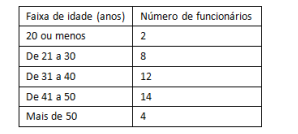
Escolhendo ao acaso um desses funcionários, a probabilidade de
que ele tenha mais de 40 anos é:
O Google permite o emprego de expressões que refinam o
processo de busca. Analise, na figura abaixo, a primeira parte do
resultado de uma busca realizada pelo Google.
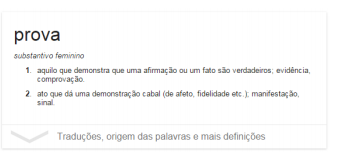
Nesse caso, o texto digitado na caixa de busca foi:
A concessão de medida liminar em mandado de segurança que ataca o lançamento tributário é causa de:
João, 75 anos, proprietário de imóvel, recebeu uma carta da
municipalidade com a comunicação de que, mesmo tendo
ocorrido o fato gerador do IPTU, não haveria necessidade de
realização do pagamento, uma vez que fora aprovada no ano
anterior uma lei que isentava os moradores com idade acima de
70 anos. Nesse caso, a lei estabeleceu uma:
A lei tributária será aplicada a fatos que venham a ocorrer após sua vacatio legis, se houver, e também a fato pretérito quando:
Uma vez regularmente notificado ao sujeito passivo, o
lançamento só pode ser alterado em virtude de:
Determinado contribuinte do IPTU não pagou o tributo relativo
ao seu único imóvel residencial nos últimos quatro anos e vem a
sofrer a execução fiscal para cobrança do imposto. Nesse caso:
Os atos administrativos emanam de agentes dotados de parcela do poder público e estão revestidos de certas características que os distinguem dos atos privados em geral, a fim de que possam alcançar a finalidade que atenda ao interesse público. Dentre tais características ou atributos, destaca-se a autoexecutoriedade, segundo a qual o ato administrativo:
Em matéria de classificação de bens públicos, quanto à destinação, de acordo com a doutrina de Direito Administrativo e com o disposto no Código Civil, os edifícios destinados a serviço ou estabelecimento da administração municipal são bens públicos:
Pedro, servidor público federal, tinha o sonho de ser eleito vereador em seu município. Apesar disso, tinha medo de perder o cargo federal caso fosse eleito e tomasse posse no cargo municipal. À luz da sistemática constitucional, caso Pedro seja investido no mandato de vereador:
Para garantir um dos objetivos da gestão de documentos – assegurar a eliminação dos documentos que não tenham valor administrativo, fiscal, legal ou para a pesquisa científica – é necessário que se faça a:
Os métodos de arquivamento dicionário e enciclopédico são exemplos de métodos:
A conexão das descrições dos documentos às informações sobre produtores e custodiadores é essencial para fornecer aos usuários uma compreensão global do material arquivístico descrito. Para fazer uma descrição normalizada das instituições custodiadoras, deve-se usar a norma:
Os documentos arquivísticos digitais gerenciados por um SiGAD devem ser preservados pelo período previsto para sua guarda, determinado na tabela de temporalidade. As ações de preservação devem ser implementadas até a sua destinação final desde:
Conforme legislação específica, os documentos referentes a projetos de pesquisa e desenvolvimento, científicos ou tecnológicos, aos quais devem ser atribuídos graus de sigilos, a eles ou às informações neles contidas, são passíveis de:
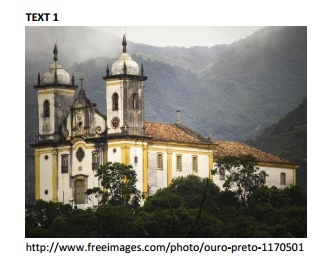
Mining tourism in Ouro Preto
Ouro Preto is surrounded by a rich and varied natural
environment with waterfalls, hiking trails and native vegetation
partially protected as state parks. Parts of these resources are
used for tourism. Paradoxically, this ecosystem contrasts with the
human occupation of the region that produced, after centuries, a
rich history and a cultural connection to mining, its oldest
economic activity which triggered occupation. The region has an
unlimited potential for tourism, especially in specific segments
such as mining heritage tourism, in association or not with the
existing ecotourism market. In fact, in Ouro Preto, tourism,
history, geology and mining are often hard to distinguish; such is
the inter-relationship between these segments.
For centuries, a major problem of mining has been the reuse of
the affected areas. Modern mining projects proposed solutions to
this problem right from the initial stages of operation, which did
not happen until recently. As a result, most quarries and other
old mining areas that do not have an appropriate destination
represent serious environmental problems. Mining tourism
utilizing exhausted mines is a source of employment and income.
Tourism activities may even contribute to the recovery of
degraded areas in various ways, such as reforestation for leisure
purposes, or their transformation into history museums where
aspects of local mining are interpreted.
Minas Gerais, and particularly Ouro Preto, provides the strong
and rich cultural and historical content needed for the
transformation of mining remnants into attractive tourism
products, especially when combined with the existing cultural
tourism of the region. Although mining tourism is explored in
various parts of the world in extremely different social, economic,
cultural and natural contexts, in Brazil it is still not a strategy
readily adopted as an alternative for areas affected by mining
activities.
(Lohmann, G. M.; Flecha, A. C.; Knupp, M. E. C. G.; Liccardo, A.
(2011). Mining tourism in Ouro Preto, Brazil: opportunities and
challenges. In: M. V. Conlin; L. Jolliffe (eds). Mining heritage and
tourism: a global synthesis. New York: Routledge, pp. 194-202.)
The sentence that best explains “Mining tourism utilizing exhausted mines is a source of employment and income.” (l. 18-19) is:
TEXT 2
Innovation is the new key to survival
[…]
At its most basic, innovation presents an optimal strategy for
controlling costs. Companies that have invested in such technologies
as remote mining, autonomous equipment and driverless trucks and
trains have reduced expenses by orders of magnitude, while
simultaneously driving up productivity.
Yet, gazing towards the horizon, it is rapidly becoming clear that
innovation can do much more than reduce capital intensity.
Approached strategically, it also has the power to reduce people and
energy intensity, while increasing mining intensity.
Capturing the learnings
The key is to think of innovation as much more than research and
development (R&D) around particular processes or technologies.
Companies can, in fact, innovate in multiple ways, such as leveraging
supplier knowledge around specific operational challenges,
redefining their participation in the energy value chain or finding new
ways to engage and partner with major stakeholders and
constituencies.
To reap these rewards, however, mining companies must overcome
their traditionally conservative tendencies. In many cases, miners
struggle to adopt technologies proven to work at other mining
companies, let alone those from other industries. As a result,
innovation becomes less of a technology problem and more of an
adoption problem.
By breaking this mindset, mining companies can free themselves to
adapt practical applications that already exist in other industries and
apply them to fit their current needs. For instance, the tunnel boring
machines used by civil engineers to excavate the Chunnel can vastly
reduce miners' reliance on explosives. Until recently, those machines
were too large to apply in a mining setting. Some innovators,
however, are now incorporating the underlying technology to build
smaller machines—effectively adapting mature solutions from other
industries to realize more rapid results.
Re-imagining the future
At the same time, innovation mandates companies to think in
entirely new ways. Traditionally, for instance, miners have focused on
extracting higher grades and achieving faster throughput by
optimizing the pit, schedule, product mix and logistics. A truly
innovative mindset, however, will see them adopt an entirely new
design paradigm that leverages new information, mining and energy
technologies to maximize value. […]
Approached in this way, innovation can drive more than cost
reduction. It can help mining companies mitigate and manage risks,
strengthen business models and foster more effective community
and government relations. It can help mining services companies
enhance their value to the industry by developing new products and
services. Longer-term, it can even position organizations to move the
needle on such endemic issues as corporate social responsibility,
environmental performance and sustainability.
(http://www2.deloitte.com/content/dam/Deloitte/ru/Document
s/energy-resources/ru_er_tracking_the_trends_2015_eng.pdf)
As regards the content of Text 3, analyse the assertions below:
I - It is well-known that the resources extracted from mines are
endless.
II - The social negative impacts of mining may be minimized as
time goes by.
III - Sustainable assessment has a wider field of action than
environmental assessment.
IV - There is agreement that negative impacts of mining are
restricted to the site.
The correct sentences are only:
Em uma urna há duas bolas pretas e duas bolas brancas. Ana
retira, aleatoriamente e sem reposição, duas bolas da urna, e
Beatriz retira as duas bolas que sobraram.
A probabilidade de Beatriz retirar duas bolas da mesma cor é:
Nas previsões sobre impactos da Copa do Mundo de Futebol da FIFA no Brasil em 2014, o Ministério do Turismo indicava que: “cerca de 3,7 milhões de turistas devem(sic) movimentar R$ 6,7 bilhões, mobilizando cerca de 200 mil trabalhadores temporários e acrescentando R$ 6,7 bilhões à economia do País.” (Publicado: Quinta, 12 de Junho de 2014, 08h59) Esse tipo de informação é característica do setor de turismo, geralmente coletada por meio de: