
INSTRUÇÃO: Leia o texto a seguir para responder à questão.
Países que garantem direitos das mulheres tendem a crescer mais
Segundo estudo, assegurar direitos femininos também traz benefícios para a saúde da população como um todo
Nações que asseguram os direitos das mulheres tendem a crescer mais rápido e a ter uma população com mais saúde, aponta um novo estudo publicado na revista BMJ
Open. E isso vale certamente para países mais pobres.
De acordo com a pesquisa, apesar de muitas nações estarem progredindo economicamente, os direitos das mulheres têm sido negligenciados em muitos lugares. E os cientistas queriam descobrir se haveria uma ligação entre a proteção dos direitos das mulheres e melhorias na saúde e no desenvolvimento sustentável.
Eles analisaram bancos de dados com informações sobre saúde, direitos humanos e direitos econômicos e sociais de 162 países no período de 2004 a 2010. As nações foram agrupadas de acordo com o número de direitos econômicos e sociais assegurados às mulheres. Entre os países selecionados, 44 foram classificados como alta adesão; 55 em nível moderado; e 63, baixo.
No geral, os países com direitos de mulheres assegurados têm melhor saúde do que aqueles onde esses direitos foram moderadamente ou pouco respeitados. Os indicadores de saúde incluem prevenção de doenças, como vacinação, saúde reprodutiva, taxas de mortalidade e expectativa de vida.
Em lugares onde os direitos humanos, incluindo os direitos das mulheres, são respeitados, mas o acesso a leitos hospitalares e médicos está abaixo da média, os resultados de saúde ainda eram consistentemente melhores do que a média. “Os resultados confirmam que, mesmo com a falta de recursos, se um país tem uma forte estrutura de direitos humanos, os resultados de saúde são melhores”, escreveram os pesquisadores.
Nos países onde apenas os direitos civis e políticos eram mais valorizados, os níveis de saúde são variados. Segundo os autores da pesquisa, mais estudos são necessários para entender melhor essa relação. “Hoje, o valor dos direitos humanos tem sido frequentemente questionado do ponto de vista econômico; no entanto, nossos dados mostram que, em vez de limitar o progresso, os direitos humanos e os direitos econômicos e sociais das mulheres, em particular, só podem trazer benefícios”, afirmam os pesquisadores, em nota à imprensa.
Disponível em: <https://revistagalileu.globo.com/Sociedade/noticia/2019/07/paises-que-garantem-direitos-das-mulherestendem-crescer-mais.html>. Acesso em: 29 jul. 2019 (Adaptação).
Esse texto tem o objetivo de
Observe a seguir o boleto bancário que Marcelo recebeu.
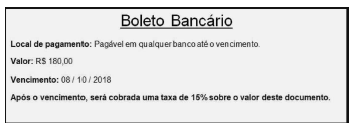
Se Marcelo pagou esse boleto após o vencimento, o valor pago por ele foi de
O quadro a seguir apresenta a promoção realizada por uma loja de produtos automobilísticos.
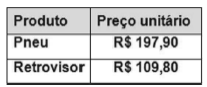
Ricardo foi até essa loja e comprou quatro pneus e dois retrovisores. Como ele efetuou o pagamento à vista, recebeu um desconto de R$ 27,50 no ato da compra.
Nessas condições, o preço total pago por Ricardo foi de
INSTRUÇÃO: Leia a tirinha a seguir para responder à questão.
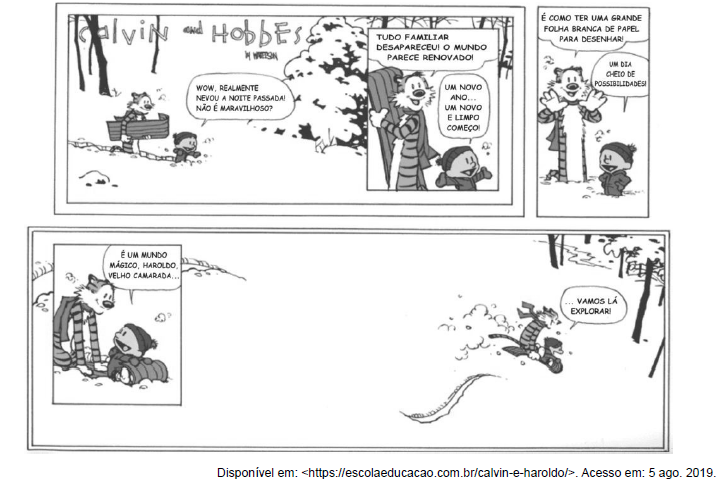
A tirinha em questão é a última da série Calvin e Haroldo, de autoria de Bill Watterson, publicada dia 31 de dezembro de 1995.
A respeito de seus possíveis significados, analise as afirmativas a seguir.
- Os elementos paratextuais dessa tirinha, como a data de sua publicação no último dia do ano e o fato de ser a última tirinha publicada com esses personagens, fornecem ao leitor mais possibilidades interpretativas.
- Há um paralelo entre a ideia de neve e a ideia de possibilidade de recomeço, o que ressignifica a ideia de fim, presente no contexto de lançamento da tirinha.
- Quando afirma, no terceiro quadrinho, que um dia coberto pela neve é como ter “uma grande folha branca de papel para desenhar”, o tigre utiliza os códigos comunicativos da tirinha para se referir a ela mesma.
Está correto o que se afirma em
Pra você ficar por dentro do que rola, convidamos a jornalista e apresentadora Renata Simões, para te guiar nesse vocabulário das ruas.
Se liga só:
Bapho: Um acontecimento para lá de inesperado, marcante. Algo que pode (ou não) causar uma revolução na vida. Às vezes é dito em tom de fofoca “preciso te contar um bapho” ou como comentário “que bapho!” Quando o bapho é muito bapho mesmo, a gente escreve com PH.
Salve: Um aceno, um alô. A gente manda salve pros amigos e quando quer avisar algo.
Tranqueira: Aquele ou aquilo que ninguém quer. Não é bom pra nada.
Causar: Tem gente que causa uma situação, um problema, um furor, uma excitação. Usado em sua maioria de maneira positiva, causar é o ato de chegar chegando ou perturbar alguma situação. O fulano pode causar no bar ao beber demais ou os amigos podem causar no show ao fazer um mosh.”
Disponível em: <https://tinyurl.com/y39xbjkr>. Acesso em: 5 ago. 2019.
A respeito do uso das gírias, assinale a alternativa incorreta.
Leia a tirinha a seguir
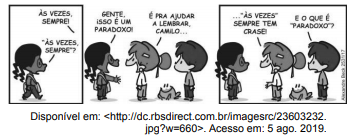
Quanto ao que afirma a tirinha, assinale com V as afirmativas verdadeiras e com F as falsas.
( ) O paradoxo reside no fato de que locuções adverbiais femininas, como “às vezes”, recebem crase em todas as incidências, o que consiste num contraste entre as ideias expressas em “às vezes” e “sempre”.
( ) O personagem Camilo identifica um paradoxo devido ao fato de que a instrução dada pela garota está errada: há casos específicos em que a locução adverbial “às vezes” não recebe crase.
( ) Se “às vezes” for grafado sem crase, a depender da frase, pode haver mudança de sentido. É a isso que o personagem Camilo se refere quando afirma haver um “paradoxo” na fala da colega.
Assinale a sequência correta.
Sobre os direitos e vantagens dos servidores públicos do município de Uberlândia previstos na Lei Complementar Municipal nº 40/1992, assinale a alternativa incorreta.
De acordo com as reflexões de Vasconcellos (2006) sobre o projeto político-pedagógico – PPP, assinale com V as afirmativas verdadeiras e com F as falsas.
( ) O PPP é considerado o plano global da escola, sendo um instrumento teórico-metodológico para intervenção e transformação da realidade.
( ) Não há distinção clara entre o PPP e o regimento escolar, uma vez que a elaboração de ambos é de competência da escola e que abordam o detalhamento administrativo e jurídico da instituição.
( ) Sendo uma das partes do marco referencial, o marco situacional expressa o ideal específico da instituição, englobando as dimensões
pedagógica, comunitária e administrativa do trabalho escolar.
( ) Cabe na realização do diagnóstico as seguintes tarefas: conhecer a realidade, julgar a realidade e localizar as necessidades.
Assinale a sequência correta.
Para Ortega e Del Rey (2002), o combate e a prevenção à violência na escola demandam estratégias educativas que promovam melhoria da convivência na comunidade escolar.
Sobre essas estratégias educativas propostas pelas autoras, assinale a alternativa incorreta.
INSTRUCTIONS: Read the text carefully and then mark the alternatives that answer the question or complete the sentences presented after it.
TEXT I
Using authentic reading materials in FLT
Let us discuss what reading in a foreign language is, how it differs from reading in one’s mother-tongue. If the foreign language learners are poor readers in their mother-tongue, we can’t expect them to read efficiently in the foreign language. But if they are good readers in
their mother-tongue, we expect them to transfer their reading strategies to the foreign language automatically. Unfortunately, this doesn’t always happen. Automatic transfer of reading strategies from L1 to L2 is difficult or never occurs. Good readers use top-down and bottom-up strategies to make predictions about the meaning of the text and check them. They vary their reading speed and strategies according to the purpose for their reading and the type of the text. When the same students read a text in the foreign language, they tend to use bottom-up strategies, i.e. their linguistic knowledge, but they rarely dare to use top-down strategies, i.e. their knowledge about the world. Appropriate reading strategies are rarely used and even some faulty reading habits, e.g. subvocalizing, regressive eye movements, etc., can be observed. So, foreign language students usually need more reading practice in order to become efficient readers in the foreign language. The use of authentic materials is an important principle of Communicative Language Teaching. In real life we read because we are interested in the communicative purpose of the text, in the ideas that the writer has expressed or the effect that the text is supposed to produce on the reader. The language in an authentic text is varied, whereas in a non-authentic one there is often one single structure that is repeated. The use of truly authentic texts is an important means of teaching students to communicate effectively.
Unfortunately, most textbooks make use of non-authentic texts. They are supposed to be easier than authentic ones and to be better suited to the students’ language proficiency level. However, this is not true because:
- non-authentic texts are usually over-explicit: they say too much because they lack the natural redundancy of authentic ones, they abound with details, so, the students are not given the chance to make any inferences;
- textbook reading materials usually deal with over-familiar topics. This can hardly be avoided at beginner level but at the higher levels the reading texts can be more informative, enjoyable and interesting;
- there is often a noticeable emphasis on the product of the activity, i.e. on the answers to the comprehension questions, over the process, i.e. the appropriate use of reading skills and strategies in order to understand the text.
We can overcome these shortcomings quite successfully if we provide supplementary authentic texts. Thus the language learners will become better readers, confident in their ability to cope with reading in real life situations.
So, why do we read? In our daily lives we read for two basic reasons: for pleasure and for information (Grellet, 1981:4). We read for information because we want to find out something, to learn something from the text, or for instruction, in order to do something with the information we get, to find out how to act. These reasons for reading are authentic. […]
Having mentioned the major drawbacks of textbook reading materials, let’s now consider the guidelines for selecting a text to supplement them or even replace them. These are the readability, the suitability of content and the exploitability of the authentic text (Nuttal, 1982:25).
- Readability means that the text should be at the right level. When we try to find a readable text, we have to assess the level of its structural and lexical difficulty. Still, we should not forget that the students can deal with more difficult texts, provided the task is not too difficult.
- Suitability of content means that the text should be interesting and informative. The students’ preferences should not be neglected and a survey of their tastes might help the teacher quite a lot.
- Exploitability means that the text should facilitate the development of reading skills in order to help the students become competent and independent readers.
However, we shouldn’t forget the fact that language classes are not entirely homogeneous: the level of the students is not the same, their tastes may vary and it is virtually impossible to create an ideal reader who could tackle all existing texts successfully. So, our goals and
criteria should be realistic.
[…]
What should be pointed out in conclusion is the vital importance of using authentic texts as supplements to textbook reading materials in order to prepare students for real life reading. Authentic texts foster the development of their reading skills thus helping them gain confidence in their reading ability in the foreign language. They become autonomous readers, who can take responsibility for their own reading.
Available at: <https://www.beta-iatefl.org/1106/blogpublications>.Accessed on: July 9th, 2019. (Adapted).
Some textbooks still make use of non-authentic texts because
INSTRUCTIONS: Read the text carefully and then mark the alternatives that answer the question or complete the sentences presented after it.
TEXT III
The cab had arrived ten minutes late, then had got stuck in a monumental traffic jam on Charing Cross Road. ‘Sorry, love, nothing doing,’ the driver had said. Joanna had looked at her watch, chucked a ten-pound note at him and jumped out of the cab. As she’d hared through
the streets towards Covent Garden, her chest laboring and her nose streaming, she’d wondered whether life could get any worse.
Joanna was snapped out of her reverie as the congregation suddenly ceased their chatter. She opened her eyes and turned round as Sir James Harrison’s family members began to file into the church.
Leading the party was Charles Harrison, Sir James’s only child, now well into his sixties. He lived in Los Angeles, and was an acclaimed director of big-budget action films filled with special effects. She vaguely remembered that he had won an Oscar some time ago, but his films weren’t the kind she usually went to see.
By Charles Harrison’s side was Zoe Harrison, his daughter. As Alec had hoped, Zoe looked stunning in a fitted black suit with a short skirt that showed her long legs, and her hair was pulled back in a sleek chignon that set off her classic English-rose beauty to perfection.
She was an actress, whose film career was on the rise, and Matthew had been mad about her. He always said Zoe reminded him of Grace Kelly his dream woman, apparently – leading Joanna to wonder why Matthew was going out with a dark-eyed, gangly brunette such as herself. She swallowed a lump in her throat, betting that Winnie the Pooh hot-water bottle that his ‘Samantha” was a petite blonde.
Holding Zoe Harrison’s hand was a young boy of around nine or ten, looking uncomfortable in a black suit and tie: Zoe’s son Jamie Harrison, named after his great-grandfather. Zoe had given birth to Jamie when she was only nineteen and still refused to name the father. Sir James had loyally defended his granddaughter and her decision to both have the baby and to remain silent about Jamie’s paternity.
Joanna thought how alike Jamie and his mother were: the same fine features, a milk and rose complexion, and huge blue eyes. Zoe Harrison kept him away from the cameras as much as possible – if Steve had got a shot of mother and son together, it would probably make the front page tomorrow morning.
Behind them came Marcus Harrison, Zoe’s brother. Joanna watched him as he drew level with her pew. Even with her thoughts still on Matthew, she had to admit Marcus Harrison was a serious ‘hottie’, as her fellow reporter Alice would say. Joanna recognised him from
the gossip columns – most recently squiring a blonde British socialite with a triple-barreled surname. As dark as his sister was fair, but sharing the same blue eyes, Marcus carried himself with louche confidence. His hair almost touched his shoulders and, wearing a crumpled black jacket and a white shirt unbuttoned at the neck, he oozed charisma. Joanna dragged her gaze away from him. Next time, she thought firmly, I’m going for a middle-aged man who likes bird watching and stamp collecting. She struggled to recall what Marcus Harrison did for a living – a fledgling film producer, she thought.
Well, he certainly looked the part.
‘Good morning, ladies and gentlemen’. The vicar spoke from the pulpit, a large picture of Sir James Harrison in front of him, surrounded with wreaths of white roses.
‘Sir James’s family welcomes you all here and thanks you for coming to pay tribute to a friend, a colleague, a father, grandfather and great-grandfather, and perhaps the finest actor of this century. For those of us who had the good fortune to know him well, it will not come as a
surprise that Sir James was adamant that this was not to be a sombre occasion, but a celebration. Both his family and I have honoured his wishes. Therefore, we start with Sir James’s favourite hymn “I Vow to Thee My Country”. Please stand’.
RILEY, Lucinda. The Love Letter. London: Pan Books, 2018,p. 13-15.
The girl first named in the text is
INSTRUCTIONS: Read the text carefully and then mark the alternatives that answer the question or complete the sentences presented after it.
TEXT III
The cab had arrived ten minutes late, then had got stuck in a monumental traffic jam on Charing Cross Road. ‘Sorry, love, nothing doing,’ the driver had said. Joanna had looked at her watch, chucked a ten-pound note at him and jumped out of the cab. As she’d hared through
the streets towards Covent Garden, her chest laboring and her nose streaming, she’d wondered whether life could get any worse.
Joanna was snapped out of her reverie as the congregation suddenly ceased their chatter. She opened her eyes and turned round as Sir James Harrison’s family members began to file into the church.
Leading the party was Charles Harrison, Sir James’s only child, now well into his sixties. He lived in Los Angeles, and was an acclaimed director of big-budget action films filled with special effects. She vaguely remembered that he had won an Oscar some time ago, but his films weren’t the kind she usually went to see.
By Charles Harrison’s side was Zoe Harrison, his daughter. As Alec had hoped, Zoe looked stunning in a fitted black suit with a short skirt that showed her long legs, and her hair was pulled back in a sleek chignon that set off her classic English-rose beauty to perfection.
She was an actress, whose film career was on the rise, and Matthew had been mad about her. He always said Zoe reminded him of Grace Kelly his dream woman, apparently – leading Joanna to wonder why Matthew was going out with a dark-eyed, gangly brunette such as herself. She swallowed a lump in her throat, betting that Winnie the Pooh hot-water bottle that his ‘Samantha” was a petite blonde.
Holding Zoe Harrison’s hand was a young boy of around nine or ten, looking uncomfortable in a black suit and tie: Zoe’s son Jamie Harrison, named after his great-grandfather. Zoe had given birth to Jamie when she was only nineteen and still refused to name the father. Sir James had loyally defended his granddaughter and her decision to both have the baby and to remain silent about Jamie’s paternity.
Joanna thought how alike Jamie and his mother were: the same fine features, a milk and rose complexion, and huge blue eyes. Zoe Harrison kept him away from the cameras as much as possible – if Steve had got a shot of mother and son together, it would probably make the front page tomorrow morning.
Behind them came Marcus Harrison, Zoe’s brother. Joanna watched him as he drew level with her pew. Even with her thoughts still on Matthew, she had to admit Marcus Harrison was a serious ‘hottie’, as her fellow reporter Alice would say. Joanna recognised him from
the gossip columns – most recently squiring a blonde British socialite with a triple-barreled surname. As dark as his sister was fair, but sharing the same blue eyes, Marcus carried himself with louche confidence. His hair almost touched his shoulders and, wearing a crumpled black jacket and a white shirt unbuttoned at the neck, he oozed charisma. Joanna dragged her gaze away from him. Next time, she thought firmly, I’m going for a middle-aged man who likes bird watching and stamp collecting. She struggled to recall what Marcus Harrison did for a living – a fledgling film producer, she thought.
Well, he certainly looked the part.
‘Good morning, ladies and gentlemen’. The vicar spoke from the pulpit, a large picture of Sir James Harrison in front of him, surrounded with wreaths of white roses.
‘Sir James’s family welcomes you all here and thanks you for coming to pay tribute to a friend, a colleague, a father, grandfather and great-grandfather, and perhaps the finest actor of this century. For those of us who had the good fortune to know him well, it will not come as a
surprise that Sir James was adamant that this was not to be a sombre occasion, but a celebration. Both his family and I have honoured his wishes. Therefore, we start with Sir James’s favourite hymn “I Vow to Thee My Country”. Please stand’.
RILEY, Lucinda. The Love Letter. London: Pan Books, 2018,p. 13-15.
In the sentence “[…] leading Joanna to wonder why Matthew was going out with a dark-eyed, gangly brunette such as herself”, the pronoun herself refers to
INSTRUCTIONS: Read the text carefully and then mark the alternatives that answer the question or complete the sentences presented after it.
TEXT III
The cab had arrived ten minutes late, then had got stuck in a monumental traffic jam on Charing Cross Road. ‘Sorry, love, nothing doing,’ the driver had said. Joanna had looked at her watch, chucked a ten-pound note at him and jumped out of the cab. As she’d hared through
the streets towards Covent Garden, her chest laboring and her nose streaming, she’d wondered whether life could get any worse.
Joanna was snapped out of her reverie as the congregation suddenly ceased their chatter. She opened her eyes and turned round as Sir James Harrison’s family members began to file into the church.
Leading the party was Charles Harrison, Sir James’s only child, now well into his sixties. He lived in Los Angeles, and was an acclaimed director of big-budget action films filled with special effects. She vaguely remembered that he had won an Oscar some time ago, but his films weren’t the kind she usually went to see.
By Charles Harrison’s side was Zoe Harrison, his daughter. As Alec had hoped, Zoe looked stunning in a fitted black suit with a short skirt that showed her long legs, and her hair was pulled back in a sleek chignon that set off her classic English-rose beauty to perfection.
She was an actress, whose film career was on the rise, and Matthew had been mad about her. He always said Zoe reminded him of Grace Kelly his dream woman, apparently – leading Joanna to wonder why Matthew was going out with a dark-eyed, gangly brunette such as herself. She swallowed a lump in her throat, betting that Winnie the Pooh hot-water bottle that his ‘Samantha” was a petite blonde.
Holding Zoe Harrison’s hand was a young boy of around nine or ten, looking uncomfortable in a black suit and tie: Zoe’s son Jamie Harrison, named after his great-grandfather. Zoe had given birth to Jamie when she was only nineteen and still refused to name the father. Sir James had loyally defended his granddaughter and her decision to both have the baby and to remain silent about Jamie’s paternity.
Joanna thought how alike Jamie and his mother were: the same fine features, a milk and rose complexion, and huge blue eyes. Zoe Harrison kept him away from the cameras as much as possible – if Steve had got a shot of mother and son together, it would probably make the front page tomorrow morning.
Behind them came Marcus Harrison, Zoe’s brother. Joanna watched him as he drew level with her pew. Even with her thoughts still on Matthew, she had to admit Marcus Harrison was a serious ‘hottie’, as her fellow reporter Alice would say. Joanna recognised him from
the gossip columns – most recently squiring a blonde British socialite with a triple-barreled surname. As dark as his sister was fair, but sharing the same blue eyes, Marcus carried himself with louche confidence. His hair almost touched his shoulders and, wearing a crumpled black jacket and a white shirt unbuttoned at the neck, he oozed charisma. Joanna dragged her gaze away from him. Next time, she thought firmly, I’m going for a middle-aged man who likes bird watching and stamp collecting. She struggled to recall what Marcus Harrison did for a living – a fledgling film producer, she thought.
Well, he certainly looked the part.
‘Good morning, ladies and gentlemen’. The vicar spoke from the pulpit, a large picture of Sir James Harrison in front of him, surrounded with wreaths of white roses.
‘Sir James’s family welcomes you all here and thanks you for coming to pay tribute to a friend, a colleague, a father, grandfather and great-grandfather, and perhaps the finest actor of this century. For those of us who had the good fortune to know him well, it will not come as a
surprise that Sir James was adamant that this was not to be a sombre occasion, but a celebration. Both his family and I have honoured his wishes. Therefore, we start with Sir James’s favourite hymn “I Vow to Thee My Country”. Please stand’.
RILEY, Lucinda. The Love Letter. London: Pan Books, 2018,p. 13-15.
The correct reported alternative for the sentence “Next time, she thought firmly, I’m going for a middle-aged man who likes bird watching and stamp collecting” is:
No traçado de eletrocardiograma, qual o significado da onda T?
A lei de dispõe sobre as condições para promoção, proteção e recuperação da saúde, e ainda regula as ações, a organização e o funcionamento dos serviços de saúde em todo pais é conhecida como:
Vygotsky atribuiu ao aprendizado importante papel no desenvolvimento da criança, uma vez que o processo de desenvolvimento avança de maneira lenta, atrás do processo de aprendizagem, e resulta de uma sequenciação que ele denominou de zona de desenvolvimento proximal.
Com base nessas informações, avalie as afirmativas a seguir e a relação proposta entre elas.
I. A zona de desenvolvimento proximal corresponde à distância entre o nível de desenvolvimento real e o potencial, determinado por meio da solução de problemas sob a orientação de um adulto,
PORQUE
II. a construção do conhecimento cognitivo é um processo sequencial marcado por etapas caracterizadas por estruturas mentais diferenciadas, em que cada etapa possui uma maneira de compreender os problemas e de resolvê-los.
Considerando essas afirmativas e sua interrelação, assinale a alternativa correta.
Sobre os princípios éticos e técnicos na elaboração de documentos escritos produzidos pelo psicólogo, decorrentes de avaliação psicológica, assinale a alternativa incorreta.
Sobre o Estatuto da Criança e do Adolescente, Lei nº 8.069, de 13 de julho de 1990, assinale com V as afirmativas verdadeiras e com F as falsas.
( ) A falta ou a carência de recursos materiais por parte da família constitui motivo suficiente para a perda ou a suspensão do poder familiar, que devem ser decretadas judicialmente.
( ) A medida de internação pode ser aplicada ao adolescente quando se tratar de ato infracional cometido mediante grave ameaça ou violência à pessoa.
( ) Quando decretada pela autoridade judiciária, a internação poderá ser cumprida em estabelecimento prisional quando inexistir na comarca entidade específica para crianças e adolescentes.
( ) É atribuição do conselho tutelar o encaminhamento de pais, crianças e adolescentes a tratamento psicológico ou psiquiátrico, quando necessário.
Assinale a sequência correta.
Segundo o Art. 52 da Norma Operacional Básica do Serviço Único da Assistência Social – SUAS, são requisitos mínimos para que os estados, o Distrito Federal e os municípios recebam os recursos referentes ao cofinanciamento federal, de acordo com o Art. 30, da LOAS, exceto:
O desenvolvimento pode ser entendido como um conjunto das transformações que ocorrem ao longo do tempo nas pessoas, expressando-se na evolução da inteligência e das modalidades de relacionamento afetivo e social.
É consenso entre os estudiosos da educação como:
No periodo da Escola Tradicional se destacou o papel dos Positivistas interessados na "formação do espírito científico", cabendo destaque ao pensador
No Brasil, o movimento da Escola Nova só começou no século XX, na década de 20, com diversas reformas esparsas do ensino público. Suas ideias expressaram-se de maneira clara em 1932, no Manifesto dos pioneiros da Educação Nova, cujo principais signatários foram:
No decorrer do período escolar, cada estudante entra em contato com um grande volume de informações a respeito do espaço geográfico brasileiro e mundial. Em cada conteúdo que lhe é apresentado, faz-se necessária a compreensão de vários conceitos geográficos que se constituem como instrumentos para uma aprendizagem efetiva. O uso indiscriminado dos termos dentro da Geografia pode conduzir ao empobrecimento do objeto de estudo e dos próprios conceitos. Então, é necessário conhecer o universo da discussão conceitual que circunda as categorias de análise que são utilizadas nas pesquisas geográficas.
LISBOA, S. S. A importância dos conceitos da Geografia para a aprendizagem de conteúdos geográficos escolares. In: Revista Ponto de Vista, v. 4, p. 23-35. 2007 (Adaptação).
Nesse contexto, considere as definições a seguir.
- Significa mais do que simplesmente uma localização geográfica, está relacionado aos diversos tipos de experiência e envolvimento com o mundo e se associa ao sentimento de pertencer a determinado espaço, de identificação pessoal com uma dada área.
- Meio no qual se desenvolvem e se manifestam os diferentes tipos de fluxos; também pode ser entendido como um conjunto de nós (elementos do espaço) interconectados, sendo nó o ponto no qual uma curva se entrecorta.
- Níveis em que o espaço é “subdividido” para melhor ser compreendido e analisado; não envolve apenas análise numérica, quantitativa, mas também qualitativa dos fenômenos analisados.
- Refere-se a “um todo” do qual derivam os demais conceitos e com o qual eles se relacionam; o homem é o seu agente por excelência – somente passa a existir quando se verifica interação entre o homem e o meio em que vive.
As definições I, II, III e IV mais se aproximam, correta e respectivamente, às seguintes categorias da análise geográfica:
Estiagens, secas, enxurradas e inundações representam cerca de 84% dos desastres naturais ocorridos no Brasil, de 1991 a 2012. Nesse período, quase 39 mil desastres
naturais registrados afetaram cerca de 127 milhões de pessoas.
A esse respeito, observe o gráfico a seguir.
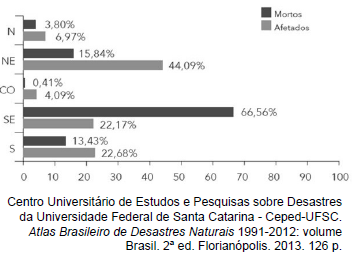
Considere as afirmativas a seguir sobre essa temática.
- O destaque da região Sudeste na proporção de mortos está relacionado à densidade demográfica: um mesmo desastre atingindo duas regiões com densidades demográficas distintas trará maiores danos para a que possuir mais habitantes por área.
- As regiões Norte e Centro-Oeste têm baixos percentuais de afetados e de mortos por desastres no país, o que está relacionado aos grandes “vazios demográficos” ainda existentes nessas regiões, pois também são afetadas por eventos naturais diversos.
- O elevado percentual de afetados em relação ao de mortos na região Nordeste é explicado pelos baixos índices de desenvolvimento humano na região, o que aumenta a vulnerabilidade social aos eventos naturais.
Estão corretas as afirmativas
No Brasil, ao se analisar o histórico de ocorrência de eventos climáticos extremos, observou-se que nos últimos 30 anos eles têm aumentado significativamente, contribuindo para a deflagração de desastres naturais. Como esses extremos são associados à variabilidade natural do clima, existem indícios de que eles seriam mais intensos e frequentes num futuro clima mais quente.
MARENGO, J. A. O futuro clima do Brasil. REVISTA USP. n. 103. p. 25-32, 2014. (Adaptação).
Analise a imagem a seguir, a respeito das projeções para as próximas décadas para o clima do Brasil por região.
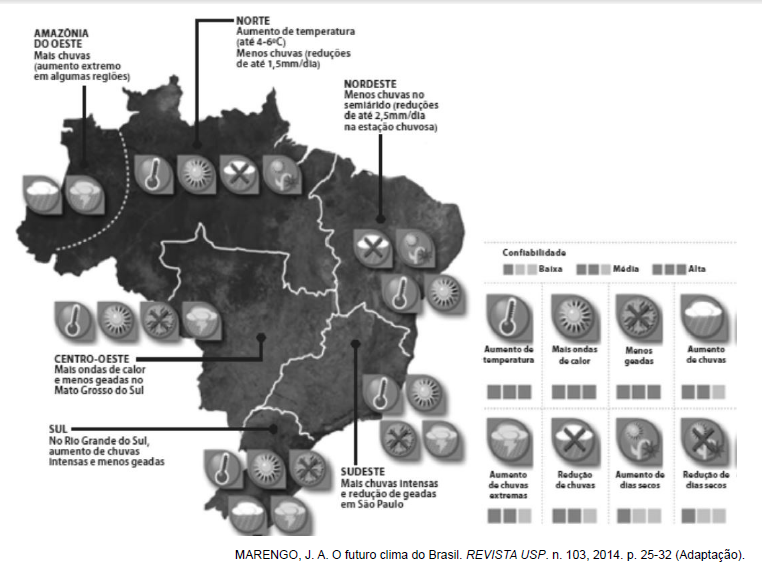
A respeito de possíveis desdobramentos desse cenário, assinale a alternativa incorreta.
Em Ensino de história e cultura africana e afro-brasileira: dilemas e desafios da recepção a 10.639/2003, Lorene Santos (2013, p. 57) assinala que nas últimas décadas o Brasil tem sido marcado pela emergência de movimentos sociais e pela intensificação de debates e discussões que visam o combate às desigualdades e a valorização da diversidade. Nesse sentido, a autora enfatiza que, para a efetivação dessas propostas, seriam necessárias mudanças ou implementações, no contexto escolar, especificamente no currículo, de uma discussão negada pela sociedade brasileira para a efetivação da referida Lei.
Em relação à efetiva implementação da Lei nº 10.639/2003, assinale a alternativa incorreta.
Em Interdisciplinaridade, transversalidade e ensino de História, Selva Guimarães analisa questões pertinentes e necessárias para uma educação em sentido mais amplo e que vise “fornecer ao indivíduo possibilidades de desenvolvimento cultural por meio da aquisição /
construção de conhecimentos formais e de instrumentos para apreender esses conhecimentos”.
GUIMARÃES, Selva. Didática e Prática de Ensino de História.Campinas: Papirus, 2012. p. 165.
Sendo assim, é incorreto afirmar que as disciplinas devem
[...] são questionáveis algumas observações de (Fernando) Novais (1986) no que se refere às interpretações das inconfidências, em especial a Mineira. Sua concepção de que as ideias que em Portugal possuíam uma face reformista, quando transpostas a uma situação colonial, ganhavam uma face ‘revolucionária’ nos parece hoje inadequada e mesmo insustentável. [...]
FURTADO, João Pinto. Inconfidências e conjurações no Brasil: notas para um debate historiográfico em torno dos movimentos do último quartel do século XVIII. In: FRAGOSO, João; GOUVÊA, Maria de Fátima. Coleção O Brasil Colonial, 1720-1821. V. 3. Rio de Janeiro: Civilização Brasileira, 2014. p. 647.
Para justificar sua contraposição a Fernando Novais, João Pinto Furtado argumenta, entre outros elementos, que
Uma pirâmide reta, de base quadrada, possui aresta lateral medindo  decímetros e diagonal da base medindo
  decímetros.
O volume dessa pirâmide, em decímetros cúbicos, é
A tendência da democracia é tratar a todos como iguais. Mesmo que a igualdade não seja garantida, é possível ser atingida: