
No que se refere à obrigação e crédito tributários, e
considerando o disposto no Código Tributário Nacional, analise as
afirmativas a seguir:
I Lei específica deve tratar das formas e condições para a
concessão de parcelamento.
II A concessão de liminar em ação cautelar ou de moratória
suspende a exigibilidade de crédito tributário e são causas de
dispensa do cumprimento das obrigações acessórias
correspondentes à obrigação principal cujo crédito seja suspenso.
III Não emitir nota fiscal em operações de venda de livros não é
suficiente para que esta obrigação acessória se transforme em
obrigação principal com relação à penalidade pecuniária.
Está correto somente o que se afirma em:
O Estado, em sua organização, atua por meio de órgãos, agentes e pessoas jurídicas, para exercer suas atividades, com vistas a atender ao interesse público. Nesse contexto, de acordo com a doutrina de Direito Administrativo, descentralização é:
Em relação à disciplina constitucional do concurso público para ingresso de pessoal no serviço público, é correto afirmar que:
Marcelo, servidor público municipal ocupante do cargo efetivo de agente fazendário, atendia a um contribuinte no balcão da repartição onde exerce suas funções, prestando-lhe informações. Por descuido, o agente público esbarrou no notebook do particular que estava regularmente sobre o balcão, derrubando-o no chão. A conduta culposa de Marcelo foi a causa eficiente do acidente e ocasionou danos materiais ao particular. No caso em tela, aplica-se a responsabilidade civil:
Na medida em que a República Federativa do Brasil encontra-se organizada sob a forma de uma Federação, formada pela União, pelos Estados, pelo Distrito Federal e pelos Municípios, é correto afirmar, em relação à divisão de competências legislativas, que:
Abel, Bruno, Caio, Diogo e Elias ocupam, respectivamente, os
bancos 1, 2, 3, 4 e 5, em volta da mesa redonda representada
abaixo.
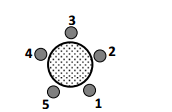
São feitas então três trocas de lugares: Abel e Bruno trocam de
lugar entre si, em seguida Caio e Elias trocam de lugar entre si e,
finalmente, Diogo e Abel trocam de lugar entre si.
Considere as afirmativas ao final dessas trocas:
• Diogo é o vizinho à direita de Bruno.
• Abel e Bruno permaneceram vizinhos.
• Caio é o vizinho à esquerda de Abel.
• Elias e Abel não são vizinhos.
É/são verdadeira(s ):
Indique, dentre os documentos listados abaixo, o que representa uma espécie documental:
A história dos arquivos está intimamente ligada à história do suporte da informação administrativa. Relacione os principais suportes utilizados com o material do qual ele é feito: I – placas ( ) folhas (vegetal) II – papiro ( ) couro III – pergaminho ( ) argila IV – códices A sequência correta é:
Considere os itens a seguir: I – Jéssica de Andrade Ramos II – Janaína Aguiar Rangel III – Jonas Alencar Rabello IV – Julio de Almeida Reis Junior V – Joel de Alcântara Reis Neto Utilizando-se as regras de alfabetação segundo o método de classificação alfabético, a sequência correta é:
Em um arquivo permanente, o instrumento de pesquisa que proporciona uma visão geral do acervo é:
Os documentos digitais podem ser classificados em estáticos e interativos, e esses últimos em dinâmicos e não dinâmicos. Um exemplo de documento digital interativo não dinâmico seria:
O arquivista, para planejar que tipo de mobiliário deve obter para dispor um acervo de documentos textuais, deve levar em consideração:
Mining tourism in Ouro Preto
Ouro Preto is surrounded by a rich and varied natural
environment with waterfalls, hiking trails and native vegetation
partially protected as state parks. Parts of these resources are
used for tourism. Paradoxically, this ecosystem contrasts with the
human occupation of the region that produced, after centuries, a
rich history and a cultural connection to mining, its oldest
economic activity which triggered occupation. The region has an
unlimited potential for tourism, especially in specific segments
such as mining heritage tourism, in association or not with the
existing ecotourism market. In fact, in Ouro Preto, tourism,
history, geology and mining are often hard to distinguish; such is
the inter-relationship between these segments.
For centuries, a major problem of mining has been the reuse of
the affected areas. Modern mining projects proposed solutions to
this problem right from the initial stages of operation, which did
not happen until recently. As a result, most quarries and other
old mining areas that do not have an appropriate destination
represent serious environmental problems. Mining tourism
utilizing exhausted mines is a source of employment and income.
Tourism activities may even contribute to the recovery of
degraded areas in various ways, such as reforestation for leisure
purposes, or their transformation into history museums where
aspects of local mining are interpreted.
Minas Gerais, and particularly Ouro Preto, provides the strong
and rich cultural and historical content needed for the
transformation of mining remnants into attractive tourism
products, especially when combined with the existing cultural
tourism of the region. Although mining tourism is explored in
various parts of the world in extremely different social, economic,
cultural and natural contexts, in Brazil it is still not a strategy
readily adopted as an alternative for areas affected by mining
activities.
(Lohmann, G. M.; Flecha, A. C.; Knupp, M. E. C. G.; Liccardo, A.
(2011). Mining tourism in Ouro Preto, Brazil: opportunities and
challenges. In: M. V. Conlin; L. Jolliffe (eds). Mining heritage and
tourism: a global synthesis. New York: Routledge, pp. 194-202.)
The opposite of the underlined word in “are often hard to distinguish” (l. 11) is:
TEXT 2
Innovation is the new key to survival
[…]
At its most basic, innovation presents an optimal strategy for
controlling costs. Companies that have invested in such technologies
as remote mining, autonomous equipment and driverless trucks and
trains have reduced expenses by orders of magnitude, while
simultaneously driving up productivity.
Yet, gazing towards the horizon, it is rapidly becoming clear that
innovation can do much more than reduce capital intensity.
Approached strategically, it also has the power to reduce people and
energy intensity, while increasing mining intensity.
Capturing the learnings
The key is to think of innovation as much more than research and
development (R&D) around particular processes or technologies.
Companies can, in fact, innovate in multiple ways, such as leveraging
supplier knowledge around specific operational challenges,
redefining their participation in the energy value chain or finding new
ways to engage and partner with major stakeholders and
constituencies.
To reap these rewards, however, mining companies must overcome
their traditionally conservative tendencies. In many cases, miners
struggle to adopt technologies proven to work at other mining
companies, let alone those from other industries. As a result,
innovation becomes less of a technology problem and more of an
adoption problem.
By breaking this mindset, mining companies can free themselves to
adapt practical applications that already exist in other industries and
apply them to fit their current needs. For instance, the tunnel boring
machines used by civil engineers to excavate the Chunnel can vastly
reduce miners' reliance on explosives. Until recently, those machines
were too large to apply in a mining setting. Some innovators,
however, are now incorporating the underlying technology to build
smaller machines—effectively adapting mature solutions from other
industries to realize more rapid results.
Re-imagining the future
At the same time, innovation mandates companies to think in
entirely new ways. Traditionally, for instance, miners have focused on
extracting higher grades and achieving faster throughput by
optimizing the pit, schedule, product mix and logistics. A truly
innovative mindset, however, will see them adopt an entirely new
design paradigm that leverages new information, mining and energy
technologies to maximize value. […]
Approached in this way, innovation can drive more than cost
reduction. It can help mining companies mitigate and manage risks,
strengthen business models and foster more effective community
and government relations. It can help mining services companies
enhance their value to the industry by developing new products and
services. Longer-term, it can even position organizations to move the
needle on such endemic issues as corporate social responsibility,
environmental performance and sustainability.
(http://www2.deloitte.com/content/dam/Deloitte/ru/Document
s/energy-resources/ru_er_tracking_the_trends_2015_eng.pdf)
The excerpt “one might argue” (l.2) expresses:
A região sombreada na figura é conhecida como “barbatana de
tubarão" e foi construída a partir de um quadrante de círculo de
raio 4 e de um semicírculo.

A área dessa “barbatana de tubarão" é: