
Attention: Read the text and answer questions 21 to 29.
A Writer's Beginnings in Kenya By ALEXANDRA FULLER
ONE DAY I WILL WRITE ABOUT THIS PLACE
A Memoir By Binyavanga Wainaina 256 pp. Graywolf Press. $24.
Dear reader, I'll save you precious time: skip this review and head directly to the bookstore for Binyavanga Wainaina's stand-upand-cheer coming-of-age memoir, "One Day I Will Write About This Place." [CONNECTIVE] written by an East African and set in East and Southern Africa, Wainaina's book is not just for Afrophiles or lovers of post-colonial literature. This is a book for anyone who still finds the nourishment of a well-written tale preferable to the empty-calorie jolt of a celebrity confessional or Swedish mystery. Not that Wainaina is likely to judge [PRONOUN] taste in books. In fact, at its heart, this is a story about how Wainaina was almost [TO EAT] alive by his addiction to reading anything available. "I am starting to read storybooks," he says of his 11-year-old self, growing up in Nakuru, Kenya. "If words, in English, arranged on the page have the power to control my body in this world, this sound and language can close its folds, like a fan, and I will slide into its world, where things are arranged differently." As he leaves childhood [ADVERB 1] − "My nose sweats a lot these days, and my armpits smell, and I wake [ADVERB 2] a lot at night all wriggly and hot, like Congo rumba music" − Wainaina retreats further from the confusing realities of politics and adolescence and his big multinational family (his father a Kenyan businessman and farm owner, his mother a Ugandan salon owner) and deeper into a world of words. At school he is told, and believes, that he is supposed to become a doctor or a lawyer, an engineer or a scientist. But Wainaina seems constitutionally incapable of absorbing anything that would further a career in these fields. By the time Wainaina leaves Kenya to attend university in South Africa, a country smoldering with the last poisonous fumes of apartheid, his addiction to books is complete. He drops out of school to pursue more completely a life of reading.
Adapted from http://www.nytimes.com/2011/08/14/books/review/one-day-i-will-write-about-this-place-by-binyavanga-wainaina-book-review.html?pagewanted=all)
De acordo com o texto,
Attention: For questions 41-43, complete the dialogue with one of the options provided below: James: KK 41 to South Africa? Kate: Yes, I have. I KK 42 there about five years ago. James: Oh, really? What KK 43 it like? Kate: One of the most beautiful countries I’ve ever seen
Attention: For questions 41-43, complete the dialogue with one of the options provided below: James: KK 41 to South Africa? Kate: Yes, I have. I KK 42 there about five years ago. James: Oh, really? What KK 43 it like? Kate: One of the most beautiful countries I’ve ever seen
I was wondering if there is anything she would like to KK to me and if she’s happy with the path I've KK in my life.
Attention: For questions 53-60, read the text below and decide which answer (A, B, C or D) best fits each gap.
Saving energy: it starts at home We already know the fastest, 53 expensive way to slow climate change: use less energy. With a little effort, and not 54
money, most of us could reduce our energy diets by 25 percent or more − 55 the Earth a favor while also helping our pocketbooks.
So what's holding us back? Scientists have reported recently that the world is heating up even faster KK 56 predicted only a few years KK 57 , and that the
consequences could be severe if we don't KK 58 reducing emission of carbon dioxide and other greenhouse gases that are trapping heat in our atmosphere. But what can we KK 59 about it as individuals? Will our efforts really KK
60 any difference?
(Extracted from the National Geographic Magazine, March 2009)
Attention: For questions 53-60, read the text below and decide which answer (A, B, C or D) best fits each gap. Saving energy: it starts at home We already know the fastest, 53 expensive way to slow climate change: use less energy. With a little effort, and not 54 money, most of us could reduce our energy diets by 25 percent or more − 55 the Earth a favor while also helping our pocketbooks. So what’s holding us back? Scientists have reported recently that the world is heating up even faster KK 56 predicted only a few years KK 57 , and that the consequences could be severe if we don’t KK 58 reducing emission of carbon dioxide and other greenhouse gases that are trapping heat in our atmosphere. But what can we KK 59 about it as individuals? Will our efforts really KK 60 any difference? (Extracted from the National Geographic Magazine, March 2009)
Uma reação em que há transformação do dióxido de carbono em monóxido de carbono é representada pela equação:

Pelo princípio de Le Chatelier,
Um imóvel vale hoje R$ 240.000,00 e estima-se que daqui a 4 anos valerá R$ 320.000,00. Admitindo-se que o valor desse imóvel seja regido por uma função do 1º grau, está correto afirmar que daqui a 6 anos esse imóvel valerá
Considere em  dois pontos coincidentes. O valor de
  e igual a Y,
Em uma distribuição uniformemente distribuída sobre o intervalo  extraiu-se uma amostra aleatória de 10 elementos, com reposição. O maior valor dos elementos desta amostra apresentou um valor igual a M. Com isto, obteve-se que o estimador de máxima verossimilhança da variância da população foi igual a 27. O estimador de máxima verossimilhança da média da população é
As medidas dos comprimentos de uma peça fabricada por uma empresa apresentam uma distribuição normal com desvio padrão desconhecido. Uma amostra aleatória de 9 peças apresentou uma média igual a 85 cm e um desvio padrão igual a 15 cm. Considerando a população de tamanho infinito e  o quantil da distribuição t de Student para teste unicaudal tal que
 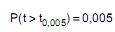 com n graus de liberdade, obteve-se, com base nessa amostra, um intervalo de confiança de 99% para a média populacional. Este intervalo de confiança, em cm, é igual a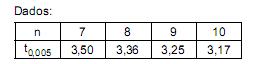
Seja X uma variável aleatória contínua com uma média igual a 20. Utilizando o Teorema de Tchebyshev, obtém-se que a probabilidade de X não pertencer ao intervalo (15, 25) é, no máximo, 6,25%. Isto significa que o desvio padrão de X é igual a
A função de distribuição empírica  abaixo corresponde a uma pesquisa realizada em 40 domicílios de uma região, em que x é o número de eleitores verificado no domicílio.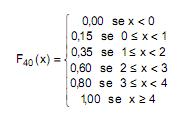
O número de domicílios em que se verificou possuir, pelo meno, 1 eleitor e no máximo 3 eleitores é
A função de probabilidade conjunta das variáveis X e Y é dada por: f (x,y) = 1 ⁄ 32 (x2 + y2 ), x = 0,1,2,3 e y = 0,1 Nessas condições, a média de Y e P(X + Y = 3) são dados, respectivamente, por
Suponha que o número de eleitores que chegam a uma seção de uma Zona Eleitoral no dia de uma determinada eleição, siga a uma distribuição de Poisson com uma média de chegada de 30 eleitores por meia hora. A probabilidade de que cheguem menos de 3 eleitores em 5 minutos é