
Atenção: As questões de 29 a 36 referem-se ao seguinte fragmento:
Conceptualizaciones de "lenguas próximas" y "vecinas"
(…)[Algunos] trabajos sobre proximidad, como los de Billiez (1996) y Dabène (1996), más centrados en los escenarios de enseñanza/aprendizaje, llaman la atención, de diferentes maneras, sobre la proximidad/distancia como percepción del aprendiz, propuesta que en nuestro medio fue también tenida en cuenta por Kulikowski y González (1999). En prácticamente toda esa producción reciente que estamos refiriendo, la intercomprensión aparece como criterio central para definir la proximidad/distancia e intentar medir sus grados. En el texto (…) de Éloy (2004: 397-398), podemos ver una propuesta de escala de seis niveles de mayor a menor proximidad, en la que el primero es la indistinción (por ejemplo, entre variedades de la misma lengua) y el último, la distancia indeterminada. Para la localización de cada par de lenguas en un grado de la escala se tienen en cuenta la intercompresión y el parentesco histórico. Sabido es que una formulación como "intercomprensión" no despierta unanimidades en las ciencias del lenguaje. (…) [Hay] Interrogantes que aparecen planteados en los trabajos que venimos mencionando, sobre todo en los más preocupados por la didáctica de lenguas. Y en alguno de ellos se intenta incluso diferenciación entre la comprensión "lingüística" y la de "referentes socioculturales" como dos variables a relacionar en la observación de cada caso de proximidad. En Robert (2004: 5), esa última distinción sirve para distinguir dos categorías, "proches" y "voisines" ("próximas" y "vecinas"): Las lenguas "vecinas" serían colaterales, variedades próximas en planos lingüístico, histórico, sociolingüístico y sociocultural, mientras las lenguas "próximas" mostrarían sólo un parentesco lingüístico. De un lado, mayor intercomprensión y semejanzas culturales, del otro, intercomprensión menos pronunciada y diferencias culturales más acentuadas*. La referencia a similitudes y diferencias "culturales", en otras partes del texto particularizadas como "referentes culturales" compartidos, muestra como surge de las reformulaciones en la secuencia explicativa transcrita arriba la necesidad de una dimensión histórico-social en la que la proximidad/distancia lingüística sea puesta en análisis. Ahora bien, saliendo del contexto europeo, en el cual los casos de vecindad o superposición geográfica son sólo uno para cada par de lenguas, ¿esa dimensión histórico-social a ser considerada en la proximidad puede ser la misma para el mismo par de lenguas en regiones del mundo cualitativamente diferentes precisamente en lo sociohistórico? ¿Podemos pensar la proximidad portuguésespañol en Europa y en América Latina como la misma proximidad? ¿sería eso viable, cuando se trata de regiones del mundo que se diferencian entre sí por el desarrollo de formaciones sociales reconocidamente distintas, y en cada una de las cuales las propias lenguas en cuestión han tenido una vida (de implantación, de contactos, de diglosias) muy diferente, merced, precisamente, a las particularidades de ese desarrollo? Nos parece que, por lo menos en el caso latinoamericano, la proximidad/distancia debe especificarse: la de estas lenguas en este espacio. ¿Significa eso que serán homogéneamente diferentes las proximidades entre portugués y español en Latinoamérica y en Europa? No, porque compartirán en buena medida los constructos político-lingüísticos de referencia y porque la variación lexical, morfosintáctica y fonética que se observa en lo que se reconoce como cada una de las lenguas atraviesa desigualmente los dos espacios, habiendo así fenómenos cuya observación puede valer tanto para un caso como para el otro. Lo que creemos es que al proponernos observar la proximidad/distancia lingüística dando atención a factores sociohistóricos que se revelan en la interacción o en la comparación de enunciados, no estamos haciendo sólo un agregado, sino proponiendo un recorte diferente, porque también en el orden lingüístico la historicidad está alojada.
* Original en francés, traducción del autor. (Fragmento adaptado de FANJUL, A. Proximidad lingüística y memoria discursiva. Reflexiones alrededor de un caso. In: Signo&Seña. Revista del Instituto de Lingüística. Facultad de Filosofía y Letras. Universidad de Buenos Aires. No 20, enero de 2009, pp. 183-205.)
Segundo o texto, a intercomprensión
Atenção: As questões de 29 a 36 referem-se ao seguinte fragmento:
Conceptualizaciones de "lenguas próximas" y "vecinas"
(…)[Algunos] trabajos sobre proximidad, como los de Billiez (1996) y Dabène (1996), más centrados en los escenarios de enseñanza/aprendizaje, llaman la atención, de diferentes maneras, sobre la proximidad/distancia como percepción del aprendiz, propuesta que en nuestro medio fue también tenida en cuenta por Kulikowski y González (1999). En prácticamente toda esa producción reciente que estamos refiriendo, la intercomprensión aparece como criterio central para definir la proximidad/distancia e intentar medir sus grados. En el texto (…) de Éloy (2004: 397-398), podemos ver una propuesta de escala de seis niveles de mayor a menor proximidad, en la que el primero es la indistinción (por ejemplo, entre variedades de la misma lengua) y el último, la distancia indeterminada. Para la localización de cada par de lenguas en un grado de la escala se tienen en cuenta la intercompresión y el parentesco histórico. Sabido es que una formulación como "intercomprensión" no despierta unanimidades en las ciencias del lenguaje. (…) [Hay] Interrogantes que aparecen planteados en los trabajos que venimos mencionando, sobre todo en los más preocupados por la didáctica de lenguas. Y en alguno de ellos se intenta incluso diferenciación entre la comprensión "lingüística" y la de "referentes socioculturales" como dos variables a relacionar en la observación de cada caso de proximidad. En Robert (2004: 5), esa última distinción sirve para distinguir dos categorías, "proches" y "voisines" ("próximas" y "vecinas"): Las lenguas "vecinas" serían colaterales, variedades próximas en planos lingüístico, histórico, sociolingüístico y sociocultural, mientras las lenguas "próximas" mostrarían sólo un parentesco lingüístico. De un lado, mayor intercomprensión y semejanzas culturales, del otro, intercomprensión menos pronunciada y diferencias culturales más acentuadas*. La referencia a similitudes y diferencias "culturales", en otras partes del texto particularizadas como "referentes culturales" compartidos, muestra como surge de las reformulaciones en la secuencia explicativa transcrita arriba la necesidad de una dimensión histórico-social en la que la proximidad/distancia lingüística sea puesta en análisis. Ahora bien, saliendo del contexto europeo, en el cual los casos de vecindad o superposición geográfica son sólo uno para cada par de lenguas, ¿esa dimensión histórico-social a ser considerada en la proximidad puede ser la misma para el mismo par de lenguas en regiones del mundo cualitativamente diferentes precisamente en lo sociohistórico? ¿Podemos pensar la proximidad portuguésespañol en Europa y en América Latina como la misma proximidad? ¿sería eso viable, cuando se trata de regiones del mundo que se diferencian entre sí por el desarrollo de formaciones sociales reconocidamente distintas, y en cada una de las cuales las propias lenguas en cuestión han tenido una vida (de implantación, de contactos, de diglosias) muy diferente, merced, precisamente, a las particularidades de ese desarrollo? Nos parece que, por lo menos en el caso latinoamericano, la proximidad/distancia debe especificarse: la de estas lenguas en este espacio. ¿Significa eso que serán homogéneamente diferentes las proximidades entre portugués y español en Latinoamérica y en Europa? No, porque compartirán en buena medida los constructos político-lingüísticos de referencia y porque la variación lexical, morfosintáctica y fonética que se observa en lo que se reconoce como cada una de las lenguas atraviesa desigualmente los dos espacios, habiendo así fenómenos cuya observación puede valer tanto para un caso como para el otro. Lo que creemos es que al proponernos observar la proximidad/distancia lingüística dando atención a factores sociohistóricos que se revelan en la interacción o en la comparación de enunciados, no estamos haciendo sólo un agregado, sino proponiendo un recorte diferente, porque también en el orden lingüístico la historicidad está alojada.
* Original en francés, traducción del autor. (Fragmento adaptado de FANJUL, A. Proximidad lingüística y memoria discursiva. Reflexiones alrededor de un caso. In: Signo&Seña. Revista del Instituto de Lingüística. Facultad de Filosofía y Letras. Universidad de Buenos Aires. No 20, enero de 2009, pp. 183-205.)
A tradução mais adequada para a forma verbal han tenido, sublinhada no sexto parágrafo do texto, é:
Atenção: As questões 37 a 44 referem-se à Proposta Curricular CBC − Língua Estrangeira − Ensino Médio da Secretaria de Estado da Educação de Minas Gerais (disponível em http://crv.educacao.mg.gov.br/, acesso em 20/08/2011).
Segundo a Proposta Curricular/MG, a proposta que contempla o trabalho com recursos não-verbais ou não-linguísticos que compõem a superfície textual é:
Atenção: O quadrinho a seguir refere-se às questões de números 46 e 47.
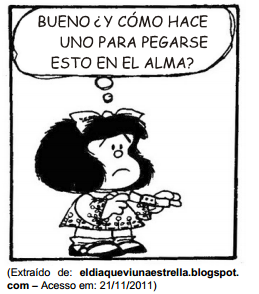
O plural do sintagma “el alma” que aparece no quadrinho anterior é "los almas", porque a regra de eufonia para o uso de artigos diante de palavras femininas iniciadas com a vogal
Atenção: O anúncio abaixo refere-se às questões de números 49 a 51.
ASPIRINETAS Aspirina 100 mg Aspirinetas contiene 100 mg. de aspirina (ácido acetilsalícico). Además de las clásicas indicaciones como analgésico, antifebril y antiinflamatorio, estas bajas dosis de aspirina están indicadas como antiagregante plaquetario, efectivas para prevenir enfermedades cardiovasculares y cerebrovasculares. A través de diversos estudios clínicos, se ha comprobado la efectividad de la aspirina en la prevención de enfermedades cardiovasculares antes de que aparezcan, lo que se conoce como prevención primaria. Aspirinetas es la marca más recomendada por los médicos porque, ante factores de riesgo, previene uno de cada tres infartos. Está clínicamente comprobado que una Aspirineta por día: − Disminuye la aparición de infartos en un 28% en individuos sanos. − Previene el tromboembolismo venoso y la embolia pulmonar. − Reduce el riesgo de infarto en un 36% en pacientes hipertensos tratados y controlados. (Extraído de: http://www.bayaspirina.com.ar/aspi.asp − Acesso: 27/08/2011)

No anúncio em questão, as partículas se, que se encontram sublinhadas no texto, são
Ao trabalhar o anúncio em questão, o professor deve, segundo as Orientações Pedagógicas: Língua Estrangeira − Ensino Médio, pedir aos alunos que
Attention: Read the text and answer questions 21 to 29.
A Writer's Beginnings in Kenya
By ALEXANDRA FULLER
ONE DAY I WILL WRITE ABOUT THIS PLACE
A Memoir By Binyavanga Wainaina
256 pp. Graywolf Press. $24.
Dear reader, I'll save you precious time: skip this review and head directly to the bookstore for Binyavanga Wainaina's stand-upand-cheer coming-of-age memoir, "One Day I Will Write About This Place." [CONNECTIVE] written by an East African and set in East and Southern Africa, Wainaina's book is not just for Afrophiles or lovers of post-colonial literature. This is a book for anyone who still finds the nourishment of a well-written tale preferable to the empty-calorie jolt of a celebrity confessional or Swedish mystery. Not that Wainaina is likely to judge [PRONOUN] taste in books. In fact, at its heart, this is a story about how Wainaina was almost [TO EAT] alive by his addiction to reading anything available. "I am starting to read storybooks," he says of his 11-year-old self, growing up in Nakuru, Kenya. "If words, in English, arranged on the page have the power to control my body in this world, this sound and language can close its folds, like a fan, and I will slide into its world, where things are arranged differently." As he leaves childhood [ADVERB 1] − "My nose sweats a lot these days, and my armpits smell, and I wake [ADVERB 2] a lot at night all wriggly and hot, like Congo rumba music" − Wainaina retreats further from the confusing realities of politics and adolescence and his big multinational family (his father a Kenyan businessman and farm owner, his mother a Ugandan salon owner) and deeper into a world of words. At school he is told, and believes, that he is supposed to become a doctor or a lawyer, an engineer or a scientist. But Wainaina seems constitutionally incapable of absorbing anything that would further a career in these fields. By the time Wainaina leaves Kenya to attend university in South Africa, a country smoldering with the last poisonous fumes of apartheid, his addiction to books is complete. He drops out of school to pursue more completely a life of reading.
(Adapted from http://www.nytimes.com/2011/08/14/books/review/one...)
The word head, as used in the text, belongs to which of the following groups?
Attention: Read the text and answer questions 21 to 29.
A Writer's Beginnings in Kenya
By ALEXANDRA FULLER
ONE DAY I WILL WRITE ABOUT THIS PLACE
A Memoir By Binyavanga Wainaina
256 pp. Graywolf Press. $24.
Dear reader, I'll save you precious time: skip this review and head directly to the bookstore for Binyavanga Wainaina's stand-upand-cheer coming-of-age memoir, "One Day I Will Write About This Place." [CONNECTIVE] written by an East African and set in East and Southern Africa, Wainaina's book is not just for Afrophiles or lovers of post-colonial literature. This is a book for anyone who still finds the nourishment of a well-written tale preferable to the empty-calorie jolt of a celebrity confessional or Swedish mystery. Not that Wainaina is likely to judge [PRONOUN] taste in books. In fact, at its heart, this is a story about how Wainaina was almost [TO EAT] alive by his addiction to reading anything available. "I am starting to read storybooks," he says of his 11-year-old self, growing up in Nakuru, Kenya. "If words, in English, arranged on the page have the power to control my body in this world, this sound and language can close its folds, like a fan, and I will slide into its world, where things are arranged differently." As he leaves childhood [ADVERB 1] − "My nose sweats a lot these days, and my armpits smell, and I wake [ADVERB 2] a lot at night all wriggly and hot, like Congo rumba music" − Wainaina retreats further from the confusing realities of politics and adolescence and his big multinational family (his father a Kenyan businessman and farm owner, his mother a Ugandan salon owner) and deeper into a world of words. At school he is told, and believes, that he is supposed to become a doctor or a lawyer, an engineer or a scientist. But Wainaina seems constitutionally incapable of absorbing anything that would further a career in these fields. By the time Wainaina leaves Kenya to attend university in South Africa, a country smoldering with the last poisonous fumes of apartheid, his addiction to books is complete. He drops out of school to pursue more completely a life of reading.
(Adapted from http://www.nytimes.com/2011/08/14/books/review/one...)
The missing [ADVERB 2] is
Attention: Read the text and answer questions 30 to 33.
Money issues aren't romantic, but they should be discussed before a wedding
By Carolyn Hax Hi, Carolyn: So, I am getting married in a few months and I've been struggling with a question: How much financial information should a couple share pre-wedding? Recently my fiancé told me that an old creditor started garnishing a portion of his paycheck. I was shocked that his finances were in such a bad state. He has always been private about money, but I didn't care much since I make my own living anyway. I'm just wondering if we need to write out all our debts and share them with each other before marriage. If so, how do I approach this topic? Anonymous You tell him the garnished paycheck surprised you, and you think it's important that both of you share full financial information − including credit scores − then fully discuss your philosophies and approaches to money. This is critical given not just his neglected debt, but also your casual attitude toward his being "private about money." If he won't share, don't marry. Seriously. And if he does share what amounts to a real mess, then postpone the wedding until he sorts himself out. This isn't about your ability to support yourself, though that helps. It's about the financial implications of the legal knot you're about to tie. Unromantic, sure, but losing a home/car, taking second or third jobs, never having a vacation and winding up in bankruptcy are all profoundly unromantic as well. (Adapted form http://www.washingtonpost.com/lifestyle/style/mone...)
According to the text,
Attention: Read the text and answer questions 34 to 40.
Our Plugged-in Summer
By BRUCE FEILER
I [TO SET OUT] to spend my summer vacation online. A few things conspired to give me the idea. The first was the insistent finger wagging one now encounters that the only way to spend quality time with one's children is to disengage from technology. The same day, my brother sent along a link for a new app (leafsnap) that allows users to identify trees by submitting photos of leaves. What a smart way to juice that nature walk, I thought. The next day I saw a Twitter message from Pierre Omidyar (@pierre), the eBay founder, in which he attached a photo and asked, "What is the name of this purple and white flower bush?" Seconds later he had his answer: lilac. Then my sister wrote to ask how she could identify the bird building a nest on her deck. "Take a picture and put it on Facebook," I said. "You'll have an answer within the hour." She bet me it wouldn't work, but within 19 minutes two friends had confirmed it was a Carolina wren. I concocted a scheme. During weekends this summer, I would pursue the opposite of an unplugged vacation: I would check screens whenever I could. Not in the service of work, but in the service of play. I would crowd-source new ideas for car games and YouTube my picnic recipes. I would test the prevailing wisdom that the Internet spoils all the fun. With back-to-school fast approaching, here's my report. For starters, the Web supplied an endless font of trivia and historical tidbits to enliven our days. I learned that a great debate still rages over who was the "Benedict" in eggs Benedict; that ancient mythologists believed fish were so afraid of the ospreys that they turned up their bellies in surrender; and that care packages like the one we sent my nephew at camp had their origins feeding starving Europeans in World War II. Online videos are another boon to summer. When my 6-year-old daughters were upset that we didn't awaken them at midnight to watch a brief light show on the Eiffel Tower, a quick trip to YouTube did the trick. My father used seaturtle.org to teach my girls how sea turtles emerge from the Atlantic near our home on Tybee Island, Ga., and lay eggs. Injured turtles are implanted with G.P.S. devices, allowing them to be tracked online. One surprising way that being plugged in improved our vacations was using newfangled resources to solve oldfangled problems. Bugs, for one. I used the Internet to find a home remedy for the slugs eating my begonias (broken eggshells). The Web also helped give us the feeling that we saw people more than we did. While it's fashionable to complain that we're overly connected, I still found an occasional, virtual interaction with a friend or family member to be as pleasant as running into them on the beach. I texted with my 12-year-old nephew about geocaching when we get together. My kids Skyped with my parents about learning to swim. And our devices were lifesavers when my daughter Tybee took a spill and had to be hurried to the hospital for stitches. A friend who took care of Tybee's twin, Eden, e-mailed us a photo of her noshing on pizza to assure us she was fine. When Tybee got nervous, the doctor asked her what movies she should download on her iPad for her son. And just before the procedure, I received a heartwarming text: "Dear Tybee, you are such a brave girl, love Eden."
(Adapted from http://www.nytimes.com/2011/08/14/fashion/this-lif...)
Infere-se do texto que
Attention: Read the text and answer questions 34 to 40.
Our Plugged-in Summer
By BRUCE FEILER
I [TO SET OUT] to spend my summer vacation online. A few things conspired to give me the idea. The first was the insistent finger wagging one now encounters that the only way to spend quality time with one's children is to disengage from technology. The same day, my brother sent along a link for a new app (leafsnap) that allows users to identify trees by submitting photos of leaves. What a smart way to juice that nature walk, I thought. The next day I saw a Twitter message from Pierre Omidyar (@pierre), the eBay founder, in which he attached a photo and asked, "What is the name of this purple and white flower bush?" Seconds later he had his answer: lilac. Then my sister wrote to ask how she could identify the bird building a nest on her deck. "Take a picture and put it on Facebook," I said. "You'll have an answer within the hour." She bet me it wouldn't work, but within 19 minutes two friends had confirmed it was a Carolina wren. I concocted a scheme. During weekends this summer, I would pursue the opposite of an unplugged vacation: I would check screens whenever I could. Not in the service of work, but in the service of play. I would crowd-source new ideas for car games and YouTube my picnic recipes. I would test the prevailing wisdom that the Internet spoils all the fun. With back-to-school fast approaching, here's my report. For starters, the Web supplied an endless font of trivia and historical tidbits to enliven our days. I learned that a great debate still rages over who was the "Benedict" in eggs Benedict; that ancient mythologists believed fish were so afraid of the ospreys that they turned up their bellies in surrender; and that care packages like the one we sent my nephew at camp had their origins feeding starving Europeans in World War II. Online videos are another boon to summer. When my 6-year-old daughters were upset that we didn't awaken them at midnight to watch a brief light show on the Eiffel Tower, a quick trip to YouTube did the trick. My father used seaturtle.org to teach my girls how sea turtles emerge from the Atlantic near our home on Tybee Island, Ga., and lay eggs. Injured turtles are implanted with G.P.S. devices, allowing them to be tracked online. One surprising way that being plugged in improved our vacations was using newfangled resources to solve oldfangled problems. Bugs, for one. I used the Internet to find a home remedy for the slugs eating my begonias (broken eggshells). The Web also helped give us the feeling that we saw people more than we did. While it's fashionable to complain that we're overly connected, I still found an occasional, virtual interaction with a friend or family member to be as pleasant as running into them on the beach. I texted with my 12-year-old nephew about geocaching when we get together. My kids Skyped with my parents about learning to swim. And our devices were lifesavers when my daughter Tybee took a spill and had to be hurried to the hospital for stitches. A friend who took care of Tybee's twin, Eden, e-mailed us a photo of her noshing on pizza to assure us she was fine. When Tybee got nervous, the doctor asked her what movies she should download on her iPad for her son. And just before the procedure, I received a heartwarming text: "Dear Tybee, you are such a brave girl, love Eden."
(Adapted from http://www.nytimes.com/2011/08/14/fashion/this-lif...)
Um fecho adequado para o texto seria
What is the correct sequence?
Attention: Read the three job announcements below and answer questions 49-52.

If you want to apply for the vacancy at Southwark College, you should do it
Attention: For questions 53-60, read the text below and decide which answer (A, B, C or D) best fits each gap.
Saving energy: it starts at home
We already know the fastest, 53 expensive way to slow climate change: use less energy. With a little effort, and not 54 money, most of us could reduce our energy diets by 25 percent or more − 55 the Earth a favor while also helping our pocketbooks. So what's holding us back? Scientists have reported recently that the world is heating up even faster 56 predicted only a few years 57 , and that the consequences could be severe if we don't 58 reducing emission of carbon dioxide and other greenhouse gases that are trapping heat in our atmosphere. But what can we 59 about it as individuals? Will our efforts really 60 any difference?
(Extracted from the National Geographic Magazine, March 2009)
Attention: For questions 53-60, read the text below and decide which answer (A, B, C or D) best fits each gap.
Saving energy: it starts at home
We already know the fastest, 53 expensive way to slow climate change: use less energy. With a little effort, and not 54 money, most of us could reduce our energy diets by 25 percent or more − 55 the Earth a favor while also helping our pocketbooks. So what's holding us back? Scientists have reported recently that the world is heating up even faster 56 predicted only a few years 57 , and that the consequences could be severe if we don't 58 reducing emission of carbon dioxide and other greenhouse gases that are trapping heat in our atmosphere. But what can we 59 about it as individuals? Will our efforts really 60 any difference?
(Extracted from the National Geographic Magazine, March 2009)