
How facial recognition technology aids police

Police officers’ ability to recognize and locate individuals with a history of committing crime is vital to their work. In fact, it is so important that officers believe possessing it is fundamental to the craft of effective street policing, crime prevention and investigation. However, with the total police workforce falling by almost 20 percent since 2010 and recorded crime rising, police forces are turning to new technological solutions to help enhance their capability and capacity to monitor and track individuals about whom they have concerns.
One such technology is Automated Facial Recognition (known as AFR). This works by analyzing key facial features, generating a mathematical representation of them, and then comparing them against known faces in a database, to determine possible matches. While a number of UK and international police forces have been enthusiastically exploring the potential of AFR, some groups have spoken about its legal and ethical status. They are concerned that the technology significantly extends the reach and depth of surveillance by the state.
Until now, however, there has been no robust evidence about what AFR systems can and cannot deliver for policing. Although AFR has become increasingly familiar to the public through its use at airports to help manage passport checks, the environment in such settings is quite controlled. Applying similar procedures to street policing is far more complex. Individuals on the street will be moving and may not look directly towards the camera. Levels of lighting change, too, and the system will have to cope with the vagaries of the British weather.
[…]
As with all innovative policing technologies there are important legal and ethical concerns and issues that still need to be considered. But in order for these to be meaningfully debated and assessed by citizens, regulators and law-makers, we need a detailed understanding of precisely what the technology can realistically accomplish. Sound evidence, rather than references to science fiction technology --- as seen in films such as Minority Report --- is essential.
With this in mind, one of our conclusions is that in terms of describing how AFR is being applied in policing currently, it is more accurate to think of it as “assisted facial recognition,” as opposed to a fully automated system. Unlike border control functions -- where the facial recognition is more of an automated system -- when supporting street policing, the algorithm is not deciding whether there is a match between a person and what is stored in the database. Rather, the system makes suggestions to a police operator about possible similarities. It is then down to the operator to confirm or refute them.
By Bethan Davies, Andrew Dawson, Martin Innes (Source: https://gcn.com/articles/2018/11/30/facial-recognitionpolicing.aspx, accessed May 30th, 2020)
Based on the information provided by Text, mark the statements below as true (T) or false (F).
( ) In relation to AFR, ethical and legal implications are being brought up.
( ) There is enough data to prove that AFR is efficient in street policing.
( ) AFR performance may be affected by changes in light and motion.
The statements are, respectively,
How facial recognition technology aids police
Police officers’ ability to recognize and locate individuals with a history of committing crime is vital to their work. In fact, it is so important that officers believe possessing it is fundamental to the craft of effective street policing, crime prevention and investigation. However, with the total police workforce falling by almost 20 percent since 2010 and recorded crime rising, police forces are turning to new technological solutions to help enhance their capability and capacity to monitor and track individuals about whom they have concerns.
One such technology is Automated Facial Recognition (known as AFR). This works by analyzing key facial features, generating a mathematical representation of them, and then comparing them against known faces in a database, to determine possible matches. While a number of UK and international police forces have been enthusiastically exploring the potential of AFR, some groups have spoken about its legal and ethical status. They are concerned that the technology significantly extends the reach and depth of surveillance by the state.
Until now, however, there has been no robust evidence about what AFR systems can and cannot deliver for policing. Although AFR has become increasingly familiar to the public through its use at airports to help manage passport checks, the environment in such settings is quite controlled. Applying similar procedures to street policing is far more complex. Individuals on the street will be moving and may not look directly towards the camera. Levels of lighting change, too, and the system will have to cope with the vagaries of the British weather.
[…]
As with all innovative policing technologies there are important legal and ethical concerns and issues that still need to be considered. But in order for these to be meaningfully debated and assessed by citizens, regulators and law-makers, we need a detailed understanding of precisely what the technology can realistically accomplish. Sound evidence, rather than references to science fiction technology --- as seen in films such as Minority Report --- is essential.
With this in mind, one of our conclusions is that in terms of describing how AFR is being applied in policing currently, it is more accurate to think of it as “assisted facial recognition,” as opposed to a fully automated system. Unlike border control functions -- where the facial recognition is more of an automated system -- when supporting street policing, the algorithm is not deciding whether there is a match between a person and what is stored in the database. Rather, the system makes suggestions to a police operator about possible similarities. It is then down to the operator to confirm or refute them.
By Bethan Davies, Andrew Dawson, Martin Innes (Source: https://gcn.com/articles/2018/11/30/facial-recognitionpolicing.aspx, accessed May 30th, 2020)
In “Until now, however”, the word “however” introduces the notion of
180 soldados serão posicionados no pátio do quartel, arrumados em linhas e colunas, de maneira a formar um retângulo perfeito. Sabe-se que tanto o número de linhas quanto o número de colunas do retângulo não podem ser menores que 5.
O maior número de arrumações possíveis para esse retângulo de soldados é
Em certa cidade, verificou-se que a quantidade de assaltos ocorridos em cada mês era inversamente proporcional ao número de policiais presentes no patrulhamento das ruas nesse mês.
Sabe-se que, em abril, 400 policiais estiveram presentes no patrulhamento e 30 assaltos ocorreram, e que, em maio, o número de assaltos caiu para 24.
O número de policiais que estiveram presentes no patrulhamento no mês de maio foi
Para aquecer a água contida em um recipiente isolado termicamente do meio ambiente, dispõe-se de uma fonte de tensão capaz de manter em seus terminais uma diferença de potencial constante, sob quaisquer condições, e três resistores de imersão idênticos, todos de mesma resistência R.
O aquecimento será mais rápido se os resistores forem ligados à fonte de tensão, como apresentado no esquema
Uma viatura está percorrendo uma estrada na qual há um longo trecho retilíneo em declive, como ilustra a figura a seguir.
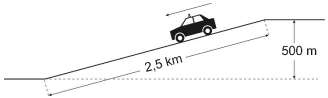
Ao longo da descida, ao ser atingida determinada velocidade, o motorista põe o carro em “ponto-morto”, para poupar combustível. Olhando para o velocímetro, o motorista percebe que o carro desce o restante da ladeira com velocidade constante. Suponha que a massa do carro com seus ocupantes e os equipamentos seja de 1200 kg e considere g = 10 m/s2. Tendo em conta as distâncias indicadas na figura, o módulo da resultante das diversas forças de atrito que se opõem ao movimento do carro, enquanto ele desce a ladeira com velocidade constante, é de
Os investigadores podem encontrar impressões digitais em objetos borrifando solução da substância X, que, ao entrar em contato com a substância Y, deixada no objeto pela pessoa que tocou nele anteriormente, reage, produzindo Z, uma substância branca que, quando exposta à luz solar, escurece, revelando as linhas das impressões digitais.
http://pibid-bio-uepg.blogspot.com/2013/08/as-funcoes-inorganicas-esua.html. Acesso em 09/06/2020. Adaptado.
A reação química descrita é:
AgNO3 + NaCl → AgCl + NaNO3
As substâncias X, Y e Z, descritas no texto, são denominadas, respectivamente,
A capacidade dos insetos de sentirem odores faz com que eles sejam os primeiros a chegar ao local de um corpo em decomposição. Os odores exalados por um cadáver vão se modificando no decorrer da decomposição, o que os torna mais ou menos atrativos para diversas espécies. A análise dos insetos encontrados em um cadáver pode determinar, entre diversos aspectos, a data da morte, o uso de drogas, o intervalo pós-morte e se o corpo foi manipulado ou transportado de um local para outro.
Sobre a biologia desses insetos, analise as afirmativas a seguir e assinale (V) para a verdadeira e (F) para a falsa.
( ) Os insetos pertencem ao filo Arthropoda, filo que agrupa o maior número de espécies animais descritas; a presença de um exoesqueleto quitinoso e as patas articuladas são características do grupo.
( ) Os insetos, em um cadáver, ocupam diversos nichos; os que se alimentam do corpo em decomposição, mas também de vegetais, são chamados onívoros.
( ) Os ovos dos insetos holometábolos (que sofrem metamorfose completa) depositados em um cadáver que contenha cocaína podem ter sua forma de desenvolvimento acelerada, dando origem a adultos sem passar pelas fases de larva e pupa.
As afirmativas são, segundo a ordem apresentada, respectivamente,
Quando um arquivo é anexado a uma mensagem de e-mail, é comum que o arquivo passe por um controle de segurança antes do envio. Um dos critérios é o tipo do arquivo, impedindo-se que arquivos executáveis, potencialmente danosos, sejam enviados. Assinale a opção que apresenta somente tipos de arquivos executáveis.
A ação popular
Na reforma agrária, segundo expressa disposição da Constituição Federal, a função social da propriedade é cumprida quando se atende, simultaneamente, aos seguintes requisitos:
Constitui mecanismo convencional estabelecido, de forma expressa, em tratado que prevê um sistema de petições individuais disposto em protocolo opcional, o Comitê
A passagem da doutrina da responsabilidade subjetiva para a da responsabilidade objetiva do Estado, na Administração Pública, foi marcada pela teoria da responsabilidade
Durante a execução orçamentária do exercício, as Defensorias Públicas Estaduais, conforme previsão expressa da Lei Complementar no 80/1994, não poderão realizar despesas que extrapolem os limites estabelecidos na lei de diretrizes orçamentárias, EXCETO se
A Emenda Constitucional no 45/2004 fortaleceu as Defensorias Públicas Estaduais, garantindo-lhes, expressamente