
TEXT 3
Sustainable mining – oxymoron or a way of the future?
Mining is an activity that has persisted since the start of humans
using tools. However, one might argue that digging a big hole in
the ground and selling the finite resources that come out of that
hole is not sustainable, especially when the digging involves the
use of other finite resources (i.e. fuels) and produces a lot of
greenhouse gases.
The counter argument could go along the lines that minerals are
not being lost or destroyed through mining and mineral
processing – the elements are being shifted around, and
converted into new forms. Metals can even be extracted from
waste, seawater or even sewage, and recycled. But a more simple
argument is possible: a mine can be sustainable if it is
economically, socially and environmentally beneficial in the short
and long term. To be sustainable, the positive benefits of mining
should outweigh any negative impacts. […]
Social positives are often associated with mines in regional areas,
such as providing better amenities in a nearby town, or providing
employment (an economic and social positive). Social negatives
can also occur, such as dust, noise, traffic and visual amenity.
These are commonly debated and, whilst sometimes
controversial, can be managed with sufficient corporate
commitment, stakeholder engagement, and enough time to work
through the issues. Time is the key parameter - it may take
several years for a respectful process of community input, but as
long as it is possible for social negatives to be outweighed by
social positives, then the project will be socially sustainable.
It is most likely that a mine development will have some
environmental negatives, such as direct impacts on flora and
fauna through clearing of vegetation and habitat within the mine
footprint. Some mines will have impacts which extend beyond
the mine site, such as disruption to groundwater, production of
silt and disposal of waste. Certainly these impacts will need to be
managed throughout the mine life, along with robust
rehabilitation and closure planning. […]
The real turning point will come when mining companies go
beyond environmental compliance to create 'heritage projects'
that can enhance the environmental or social benefits in a
substantial way – by more than the environmental offsets
needed just to make up for the negatives created by the mine. In
order to foster these innovative mining heritage projects we need
to promote 'sustainability assessments' - not just 'environmental
assessments'. This will lead to a more mature appreciation of the
whole system whereby the economic and social factors, as well as
environmental factors, are considered in a holistic manner.
(adapted from https://www.engineersaustralia.org.au/westernaustralia-division/sustainable-mining-oxymoron-or-way-future.
Retrieved on August 10, 2015)
The excerpt “one might argue” (l.2) expresses:
A figura abaixo mostra a planta de um salão. Os ângulos A, B, C, D
e E são retos e as medidas assinaladas estão em metros.
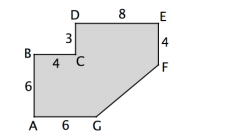
A área desse salão em m²
é:
Analise as seguintes afirmativas a respeito da tecnologia de rastreamento de emissões, denominada Direction Finding – DF. I Permite a determinação automática dos ângulos de azimute e de elevação de um determinado emissor a partir da avaliação do sinal eletromagnético emitido por ele ou pelo próprio emissor. II Permite a localização do emissor quando empregados três ou mais sistemas em conjunto, a partir de localizações distintas e alinhadas. III. Permite o cálculo do azimute considerando que o sinal incidente é uma onda plana e que a elevação do emissor é nula. Está correto somente o que se afirma em:
As tecnologias WiMAX e LTE são tecnologias recentes para a transmissão de dados. A respeito delas, é correto afirmar que:
A rede de dados que permite a ligação de redes e equipamentos em uma área metropolitana, no entanto, sem alcançar uma grande área geográfica, como um país ou continente, é:
Uma técnica utilizada para a distribuição de conteúdo na Internet é Content Distribution Networks – CDNs. A respeito dessa técnica, é correto afirmar que:
Uma rede possui um tempo médio entre falhas de 2.000 horas e tempo médio de reparação de 50 horas. Essa rede opera ininterruptamente por um período de 9 meses. Considerando 30 dias para o mês, a disponibilidade dessa rede, em horas, é aproximadamente de:
A respeito do Common Management Information Protocol – CMIP, considere as seguintes afirmativas: I O protocolo CMIP é o protocolo OSI do Nível de Rede orientado a conexão. II No ambiente de gerenciamento OSI, o protocolo CMIP é utilizado para definir as regras de comunicação entre os processos gerente e agente. III O CMIP é incompatível com o Common Management Information Service - CMIS. Está correto somente o que se afirma em:
A respeito da Next Generation Networks - NGN analise as seguintes afirmativas. I Utiliza-se de tecnologias baseadas em padrões abertos definidos pelo ITU-T. II Tem por objetivo a convergência dos serviços existentes em uma única arquitetura de serviços convergentes. III Possui uma infraestrutura de redes independente. Está correto somente o que se afirma em:
A variação estatística do atraso na entrega de dados na transmissão de uma mensagem na rede, que pode resultar na perda da informação no destino, pode ser causado por:
A Lei nº 8.666/93 dispõe que a licitação destina-se a garantir a observância do princípio constitucional da isonomia, a seleção da proposta mais vantajosa para a administração e a promoção do desenvolvimento nacional sustentável e será processada e julgada em estrita conformidade com alguns princípios básicos, como o da:
No caso da intervenção do Estado na propriedade, o poder público age de forma vertical, criando imposições que, de alguma forma, restringem o seu uso pelo seu dominus, com fundamento na supremacia do interesse público sobre o privado e na função social da propriedade. Nesse contexto, é hipótese de intervenção do Estado na propriedade, na modalidade servidão administrativa:
Aílton, cidadão exemplar e que sempre pagava as suas obrigações
em dia, foi surpreendido com três cobranças emitidas pelo
Município em que residia. A primeira era um imposto, a segunda,
uma taxa e, a terceira, uma contribuição de melhoria. Surpreso
com as cobranças, procurou o seu amigo Eulálio para que lhe
explicasse a distinção entre essas espécies tributárias. Apesar de
solícito, Eulálio deixou claro que somente conhecia o que
constava da Constituição da República Federativa do Brasil,
ignorando por completo o que dispunha a legislação
infraconstitucional. À luz do Sistema Tributário Nacional, tal qual
delineado na Constituição da República Federativa do Brasil, é
correto afirmar que:
Os 12 funcionários de uma repartição da prefeitura foram
submetidos a um teste de avaliação de conhecimentos de
computação e a pontuação deles, em uma escala de 0 a 100, está
no quadro abaixo.

O número de funcionários com pontuação acima da média é:
Para pagamento de boleto com atraso em período inferior a um mês, certa instituição financeira cobra, sobre o valor do boleto, multa de 2% mais 0,4% de juros de mora por dia de atraso no regime de juros simples. Um boleto com valor de R$ 500,00 foi pago com 18 dias de atraso. O valor total do pagamento foi: