
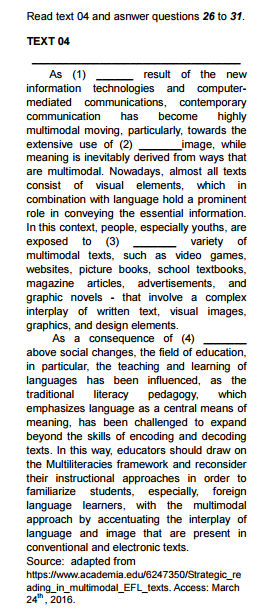
Considering the context of use in the text 04, the words "teaching" and "learning" (line 22) in the second paragraph are
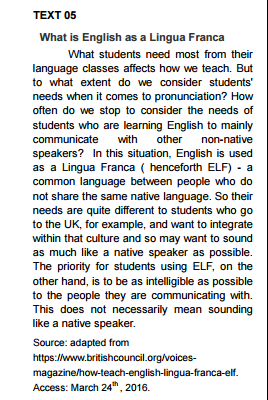
Considering the words taken from the text 05, the underlined words with the appropriate stress syllable are
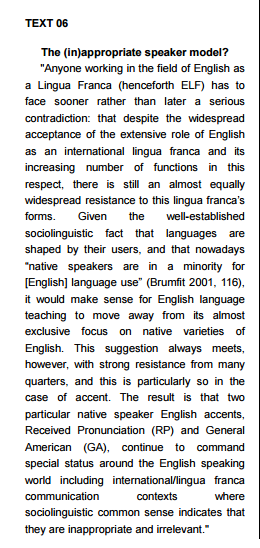
In the text 06, the numbers "116” (line 14) and "35" (in the referenc(E), are, in compliance with Bristish usage, written respectively as:
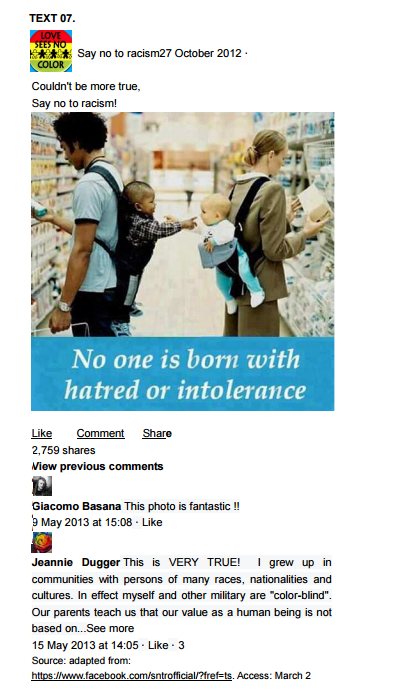
In the sentence “Couldn't be more true” the modal express the idea of:
As questões 03 a 05 referem-se ao Texto 1.
Texto 1
“John Reed was a schoolboy of fourteen years old;
four years older than I, for I was but ten: large and
stout for his age, with a dingy and unwholesome
skin; thick lineaments in a spacious visage, heavy
limbs and large extremities. He gorged himself
habitually at table, which made him bilious, and
gave him a dim and bleared eye and flabby cheeks.
He ought now to have been at school; but his mama
had taken him home for a month or two, „on account
of his delicate health.‟ Mr. Miles, the master,
affirmed that he would do very well if he had fewer
cakes and sweetmeats sent him from home; but the
mother‟s heart turned from an opinion so harsh, and
inclined rather to the more refined idea that John‟s
sallowness was owing to over-application and,
perhaps, to pining after home. John had not much
affection for his mother and sisters, and an antipathy
to me. He bullied and punished me; not two or three
times in the week, nor once or twice in the day, but
continually: every nerve I had feared him, and every
morsel of flesh in my bones shrank when he came
near. There were moments when I was bewildered
by the terror he inspired, because I had no appeal
whatever against either his menaces or his
inflictions; the servants did not like to offend their
young master by taking my part against him, and
Mrs. Reed was blind and deaf on the subject: she
never saw him strike or heard him abuse me,
though he did both now and then in her very
presence, more frequently, however, behind her
back."
(Extract from http://www.planetpdf.com/planetpdf/pdfs/free_ebooks/jane_eyre_nt.pdf
Accessed on 20 April 2016.)
In the fragment, “…she never saw him strike
or heard him abuse me, though he did both now and
then in her very presence, more frequently,
however, behind her back.…", the underlined clause
is an example of a:
As questões 06 a 10 referem-se ao Texto 2.
Texto 2
Multicultural Education in Your Classroom
By: E.K. Garcia
America has always been referred to as a melting
pot, but ideally, it's a place where we strive to invite
everyone to celebrate exactly who they are. As the
US. population is becoming increasingly diverse and
technology makes the world feel increasingly
smaller, it is time to make every classroom a
multicultural classroom.
Multicultural education is more than celebrating
Cinco de Mayo with tacos and piñatas or reading
the latest biography of Martin Luther King Jr. It is an
educational movement built on basic American
values such as freedom, justice, opportunity, and
equality. It is a set of strategies aimed to address
the diverse challenges experienced by rapidly
changing U.S. demographics. And it is a beginning
step to shifting the balance of power and privilege
within the education system.
The goals of multicultural education include creating
a safe, accepting and successful learning
environment for all, increasing awareness of global
issues, strengthening cultural consciousness,
strengthening intercultural awareness, teaching
students that there are multiple historical
perspectives, encouraging critical thinking and
preventing prejudice and discrimination.
According to the National Association for
Multicultural Education (NAME), the advantages of
multicultural education are helping students develop
positive self-image, offering students an equitable
educational opportunity, allowing multiple
perspectives and ways of thinking, combating
stereotypes/prejudicial behavior and teaching
students to critique society in the interest of social
justice.
Contrary to popular belief, multicultural education is
more than cultural awareness, but rather an initiative
to encompass all under-represented groups (people
of color, women, people with disabilities, etc) and to
ensure curriculum and content including such
groups is accurate and complete.
Most curriculums focus more on North America and
Europe than any other region. Most students have
learned about genocide through stories of the
Holocaust, but do they know that hundreds of
thousands of people are being killed in places like
Darfur and Rwanda? Despite our close proximity to
Latin America, American schools typically spend
little time reading Latin American literature or
learning about the culture and history.
_______, multicultural education is most successful
when implemented as a schoolwide approach with
reconstruction of not only curriculum, but also
organizational and institutional policy. Educators
must be aware, responsive and embracing of the
diverse beliefs, perspectives and experiences. They
must also be willing and ready to address issues of
controversy.
These issues include, but are not limited to, racism,
sexism, religious intolerance, classism, ageism, etc.
(Adapted from http://www.teachhub.com/multiculturaleducation-your-classroom
Accessed on 21 April 2016)
According to the author, it can be said that one of the gains of multicultural education is to:
When teaching reading skills, teachers need to teach different ways of reading a text. The instruction which is related to reading for gist is represented by:
Choose the correct sequence of the synonyms of the following phrasal verbs: turn up, bring off, keep on, put off, break in:
All the following options can be considered “cultural cautions” in a presentation, except:
Mark the correct option:
It _______ been raining for hours.

On the ideas of the text and the vocabulary used in it, judge the next items.
Replacing “earlier” (l.17) by older changes the meaning of the last sentence of the text.
On the ideas of the text and the vocabulary used in it, judge the next items.
File format and filename extension refer to different characteristics of a file.