
No fi nal do Período Colonial, a extensão territorial da Colônia
nada tinha a ver com a linha de Tordesilhas. As bandeiras paulistas,
para oeste, a ação dos criadores de gado e das forças militares,
para sudoeste, e o avanço minerador, a partir do século XVIII,
tornaram a feição territorial do Brasil bastante próxima da atual.
Restava discutir, principalmente com a Espanha, o reconhecimento
das novas fronteiras. Embora as controvérsias sobre as fronteiras
do Sul não tivessem cessado, o Tratado, anterior ao de Santo Ildefonso,
que reconhece a posse para quem fosse ocupante efetivo
de uma área é conhecido como Tratado:
Quando trata do tema da distinção entre as várias dimensões da cidadania, T.A. Marshall (Apud CARVALHO, 2001) faz uma exceção na sequência de direitos da cidadania estabelecida por ele e que coloca os direitos sociais como os últimos conquistados na Inglaterra. O direito social que tem sido historicamente, segundo o autor, um pré-requisito para a expansão dos outros direitos é:
A frase célebre, “Nada se assemelha mais a um ‘saquarema’ do que um ‘luzia’ no poder”, cuja autoria é dada ao político pernambucano Holanda Cavalcanti, e trata ironicamente das características normalmente atribuídas às agremiações políticas que se consolidaram como os dois grandes partidos políticos imperiais do Segundo Reinado, signifi ca que:
Questions 21 through 35 address existing theories of English teaching.
Read them and mark the correct alternative.
In the article “Ensino de Línguas: passado, presente e futuro”, Vilson Leffa (2012) predicts a certain “invisibility” to teachers in the future. According to the author, this “invisibility” means:
Questions 21 through 35 address existing theories of English teaching.
Read them and mark the correct alternative.
In “Ofi cina de Linguística Aplicada”, Moita Lopes (1996) discusses the concept of “self-fulfi lling prophecy”, presented by Rosenthal and Jacobson in 1973. The author particularly uses this concept to tackle the belief of failure, which:
Questions 21 through 35 address existing theories of English teaching.
Read them and mark the correct alternative.
Assuming that current language teaching tends to be eclectic in terms of approaches and that this might result in inconsistent and unfounded practice, Harmer (2007) recommends three essential elements for any teaching sequence: engage, study and activate. The alternative with a correct example of one of these elements is:
Questions 21 through 35 address existing theories of English teaching.
Read them and mark the correct alternative.
In “Teaching Reading Skills in a Foreign Language”, Nuttall
(1996, p. 39) presents some reading strategies. According to the
author, some of them are obvious and some are more complex.
The correct correspondence between the strategy and the type is:
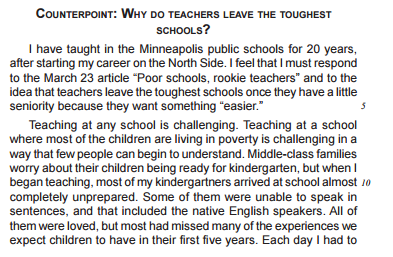
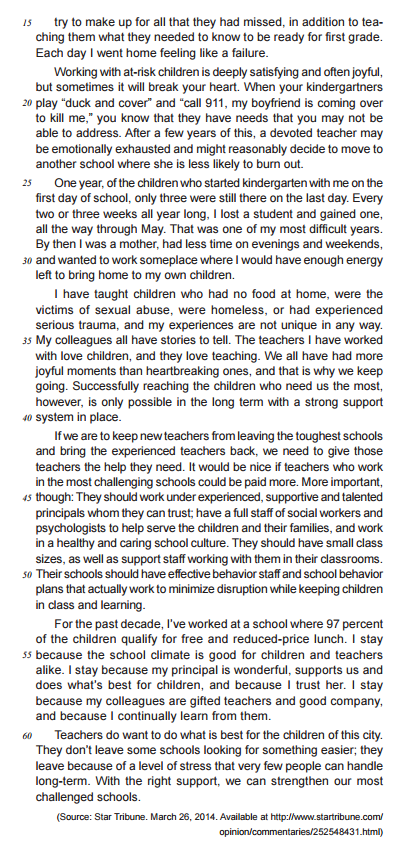
According to the Longman Grammar (Biber et al., 1999), it is diffi cult to identify the intended time reference for the past perfect, because the reference depends on the context. In “All of them were loved, but most had missed many of the experiences we expect children to have in their fi rst fi ve years.” (l. 12), the time reference for the past perfect verb phrase is:
Questions 46 through 50 present some problems English learners
usually have. Mark the correct alternative for each question.
Suppose you are correcting some literary essays. In one
essay, you fi nd the following extract.
“It begins with the Giant coming back to his garden after a
seven-year trip. When arriving they see that children play in his
garden.” (source: a real student’s essay)
The mistake that directly affects the cohesion of the extract is the/a:
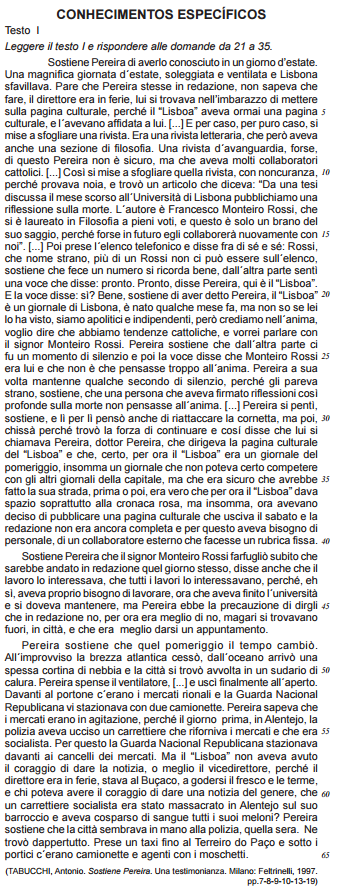
Individuare l'affermazione corretta rispetto a quanto esposto
nel testo I:
Nel costrutto “... perchéforse in futuro egli collaborerá nuovamente
con noi." (r. 15), le parole in neretto indicano rispettivamente:
Nel brano selezionato “... e chi poteva avere il coraggio di
dare una notizia del genere...," (r. 60) il valore della parola in neretto
è pronome:
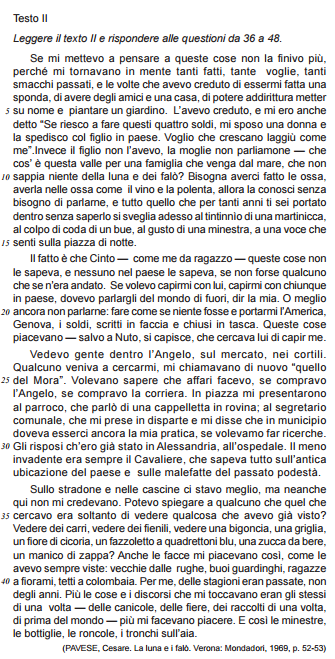
L'opzione in cui tutte e tre tecniche vengono utilizzate per
guidare e verifi care l'abilità di comprensione è: