
Com relação ao processo de elaboração do orçamento, no tocante às estimativas de receitas orçamentárias, avalie se as afirmativas a seguir são falsas (F) ou verdadeiras (V).
( ) Na ótica das estimativas de receitas orçamentárias, são irrelevantes quaisquer justificativas que apresentem como fundamento a necessidade do gasto.
( ) É motivação para a alteração nas estimativas de receita a existência de alterações nas alíquotas ou valores de taxas, tarifas e/ou serviços públicos.
( ) É irrelevante a acurácia na estimação da receita para o efeito da execução orçamentária.
( ) Em relação ao anexo de metas fiscais, este deve trazer demonstrativo para a estimativa e a compensação das renúncias de receitas e da margem das despesas discricionárias.
As afirmativas são, respectivamente,
Sobre a diversificação de carteiras, analise as afirmativas a seguir.
I. Considere uma carteira formada por apenas dois ativos. Se a correlação entre esses ativos for 0, haverá sempre uma combinação desses ativos em que o risco da carteira é zero.
II. Uma carteira possui retorno esperado R e desvio-padrão  . Suponha que se acrescente à carteira um ativo que possui retorno esperado R, desvio-padrão
  e correlação igual a 0,7 com a carteira. O desvio-padrão da nova carteira (a carteira inicial mais o ativo) é menor que
  .
.
III. Uma fronteira eficiente é um conjunto de carteiras que possuem risco mínimo para cada nível de retorno esperado.
Está correto apenas o que se afirma em
Com relação aos instrumentos de planejamento e orçamento, avalie se as afirmativas a seguir são falsas (F) ou verdadeiras (V).
( ) O PPA é o instrumento de planejamento de médio prazo do governo federal que estabelece, de forma regionalizada, as diretrizes, os objetivos e as metas da Administração Pública Federal para as despesas de capital e outras delas decorrentes e para as relativas aos programas de duração continuada.
( ) A LDO deve incluir o anexo de metas fiscais, no qual são avaliados os passivos contingentes.
( ) A LOA é doutrinariamente conhecida como o planejamento operacional da Administração Pública, cuja metodologia brasileira utilizada para sua elaboração é denominada de orçamento por desempenho.
As afirmativas são, respectivamente,
Dada a necessidade de reforço das medidas de segurança contra incêndios nos estabelecimentos penitenciários sob a jurisdição da SEAP/BA, seu setor de compras realizou um levantamento referente a preços de extintores de incêndio, além de suas demandas internas em quantidade e custo total por tipo de extintor.
Esse levantamento gerou a planilha de Excel (integrantes da suíte Microsoft 365, versão português), apresentada a seguir: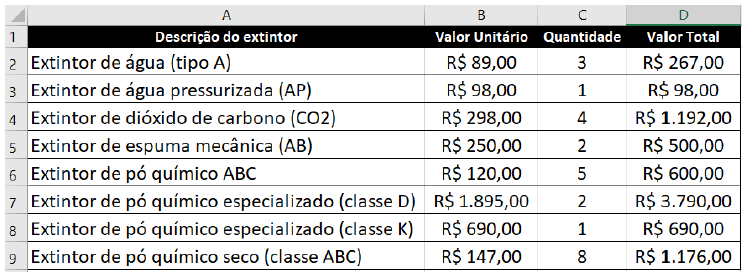
As colunas B e D estão formatadas com o tipo “Moeda”. A coluna A está formatada como “Texto” e a coluna C, como “Geral”.
Ao analisar a planilha, é possível afirmar que a aplicação da fórmula:
Text I
Office Culture
Companies are clawing to bring back pre-pandemic perks and that 'family'
feeling – but employees want something more tangible.
Many employers are calling employees back into offices, trying
to restore the workplace of pre-pandemic days. Along with filling
seats, they're also looking to bring back another relic: office
culture.
Pre-2020, office culture was synonymous with the 'cool' office:
think places to lounge, stocked pantries and in-office happy hours
that went all out; or luxe retreats and team-building exercises
meant to foster the feeling of 'family'. In past years, these perks
drew many workers to the office – in some cases, entire companies
defined themselves by their office cultures.
The world of work looks and feels entirely different than just a
few years ago – yet many companies are still intent on recreating
the office cultures workers left behind as they abandoned their
desks in 2020. While these companies are making some gestures
to adapt – for instance, redesigning spaces to accommodate new
preferences and hybrid-work habits – many are still set on bringing
back what lured in workers before the pandemic.
Yet swaths of employees simply aren't interested in going
backward. Instead of trust-falls and cold brew on tap, employees
are demanding flexible work, equitable pay and a focus on
humanity in the workplace that transcends the perks they sought
years earlier.
Workers' shifting priorities are a natural consequence of the
Covid-19 pandemic, says Georgina Fraser, head of human capital
for global commercial real-estate firm CBRE. "The pandemic gave
us autonomy in a way that we haven't had previously," she says.
"It gave us the opportunity to choose how we structured our
working days." And now that workers have experienced that level of work-life
balance, they won't settle for less. Fraser adds: "Post-pandemic,
we saw a resurgence of people being very vocal about what they
wanted and needed, not just from office culture, but from the
wider world."
Now, she says, workers aren't shy about "wanting to be seen
as a whole human – and that filters down to their physical location,
how [employers] manage them, what support they receive and
how [employers] integrate technologies between home and office
in order to support them".
One major factor in this changing attitude is that many
employees feel office culture simply isn't applicable in a remote and hybrid-first world, where the physical office can feel
superfluous. Now that the workplace doesn't serve as the culture
hub it once did, "companies have really struggled to redefine the
role of the office", says Lewis Beck, CBRE's head of workplace for
Europe. Office culture that was once meant to get employees
excited doesn't have the same pull when workplaces are only one third full.
Adapted from: https://www.bbc.com/worklife/article/20240229-office-culture-is dead
The extract Companies are clawing (in the subtitle) suggests that
the effort expended by the companies is
Text I
Office Culture
Companies are clawing to bring back pre-pandemic perks and that 'family'
feeling – but employees want something more tangible.
Many employers are calling employees back into offices, trying
to restore the workplace of pre-pandemic days. Along with filling
seats, they're also looking to bring back another relic: office
culture.
Pre-2020, office culture was synonymous with the 'cool' office:
think places to lounge, stocked pantries and in-office happy hours
that went all out; or luxe retreats and team-building exercises
meant to foster the feeling of 'family'. In past years, these perks
drew many workers to the office – in some cases, entire companies
defined themselves by their office cultures.
The world of work looks and feels entirely different than just a
few years ago – yet many companies are still intent on recreating
the office cultures workers left behind as they abandoned their
desks in 2020. While these companies are making some gestures
to adapt – for instance, redesigning spaces to accommodate new
preferences and hybrid-work habits – many are still set on bringing
back what lured in workers before the pandemic.
Yet swaths of employees simply aren't interested in going
backward. Instead of trust-falls and cold brew on tap, employees
are demanding flexible work, equitable pay and a focus on
humanity in the workplace that transcends the perks they sought
years earlier.
Workers' shifting priorities are a natural consequence of the
Covid-19 pandemic, says Georgina Fraser, head of human capital
for global commercial real-estate firm CBRE. "The pandemic gave
us autonomy in a way that we haven't had previously," she says.
"It gave us the opportunity to choose how we structured our
working days." And now that workers have experienced that level of work-life
balance, they won't settle for less. Fraser adds: "Post-pandemic,
we saw a resurgence of people being very vocal about what they
wanted and needed, not just from office culture, but from the
wider world."
Now, she says, workers aren't shy about "wanting to be seen
as a whole human – and that filters down to their physical location,
how [employers] manage them, what support they receive and
how [employers] integrate technologies between home and office
in order to support them".
One major factor in this changing attitude is that many
employees feel office culture simply isn't applicable in a remote and hybrid-first world, where the physical office can feel
superfluous. Now that the workplace doesn't serve as the culture
hub it once did, "companies have really struggled to redefine the
role of the office", says Lewis Beck, CBRE's head of workplace for
Europe. Office culture that was once meant to get employees
excited doesn't have the same pull when workplaces are only one third full.
Adapted from: https://www.bbc.com/worklife/article/20240229-office-culture-is dead
The extract what lured in workers (3rd paragraph) implies that
workers were
Text I
Office Culture
Companies are clawing to bring back pre-pandemic perks and that 'family'
feeling – but employees want something more tangible.
Many employers are calling employees back into offices, trying
to restore the workplace of pre-pandemic days. Along with filling
seats, they're also looking to bring back another relic: office
culture.
Pre-2020, office culture was synonymous with the 'cool' office:
think places to lounge, stocked pantries and in-office happy hours
that went all out; or luxe retreats and team-building exercises
meant to foster the feeling of 'family'. In past years, these perks
drew many workers to the office – in some cases, entire companies
defined themselves by their office cultures.
The world of work looks and feels entirely different than just a
few years ago – yet many companies are still intent on recreating
the office cultures workers left behind as they abandoned their
desks in 2020. While these companies are making some gestures
to adapt – for instance, redesigning spaces to accommodate new
preferences and hybrid-work habits – many are still set on bringing
back what lured in workers before the pandemic.
Yet swaths of employees simply aren't interested in going
backward. Instead of trust-falls and cold brew on tap, employees
are demanding flexible work, equitable pay and a focus on
humanity in the workplace that transcends the perks they sought
years earlier.
Workers' shifting priorities are a natural consequence of the
Covid-19 pandemic, says Georgina Fraser, head of human capital
for global commercial real-estate firm CBRE. "The pandemic gave
us autonomy in a way that we haven't had previously," she says.
"It gave us the opportunity to choose how we structured our
working days."
And now that workers have experienced that level of work-life
balance, they won't settle for less. Fraser adds: "Post-pandemic,
we saw a resurgence of people being very vocal about what they
wanted and needed, not just from office culture, but from the
wider world."
Now, she says, workers aren't shy about "wanting to be seen
as a whole human – and that filters down to their physical location,
how [employers] manage them, what support they receive and
how [employers] integrate technologies between home and office
in order to support them".
One major factor in this changing attitude is that many
employees feel office culture simply isn't applicable in a remote and hybrid-first world, where the physical office can feel
superfluous. Now that the workplace doesn't serve as the culture
hub it once did, "companies have really struggled to redefine the
role of the office", says Lewis Beck, CBRE's head of workplace for
Europe. Office culture that was once meant to get employees
excited doesn't have the same pull when workplaces are only one third full.
Adapted from: https://www.bbc.com/worklife/article/20240229-office-culture-is dead
When it is argued that workers aren't shy (7th paragraph), the author means they are
A alavancagem financeira impacta o fator de risco sistêmico de um
ativo financeiro ou real, assim como o custo do capital.
A esse respeito, considere a expressão:

em que: 0 < t < 1, CP é o valor do capital próprio, D o valor da
Dívida,
As empresas estatais, ao realizarem licitações, devem seguir a Lei nº 13.303/2016, que estabelece normas para esses processos e
contratos. Os contratos resultantes devem ser rigorosamente geridos para garantir o cumprimento das cláusulas, incluindo a
fiscalização dos serviços e a aplicação de penalidades em casos de inadimplência.
Assinale a opção que apresenta a situação na qual as empresas
públicas são dispensadas da precedência de licitação.
Assinale a opção que indica a frase em que a substituição de um infinitivo pelo substantivo correspondente foi feita de forma
inadequada.
O protocolo IPSEC (Internet Protocol Security) é amplamente utilizado para proteger comunicações IP com autenticação e
criptografia.
O protocolo IPSEC pode operar em dois modos principais: modo transporte e modo túnel. Compreender a diferença entre esses
modos é crucial para a implementação eficaz de segurança nas comunicações.
Nesse sentido, assinale a opção que apresenta a principal diferença entre eles.
A concepção do endereçamento IPv6 foi essencial para suprir à escassez de endereços no IPv4, oferecendo maior oferta de
endereços para dispositivos em redes de dados, melhor segurança e suporte aprimorado para novas tecnologias.
Sobre o endereçamento IPv6, analise as afirmativas a seguir.
I. O EUI-64 (Extended Unique Identifier-64) é um método que
permite que as máquinas utilizem os 48 bits do seu endereço
MAC para gerar os 64 bits menos significativos do endereço IPv6.
Isso é feito por meio da inserção dos hexadecimais “FFFE” no
meio do endereço MAC original e da inversão de valor do bit 7,
(7º bit da esquerda para a direita) do mesmo endereço MAC.
II. No endereçamento IPv6 são admitidas as formas de
encaminhamento de pacotes unicast, multicast, anycast e
broadcast.
III. Endereços link-local IPv6 são endereços que são válidos
apenas dentro de um único link ou segmento de rede local.
Eles são utilizados para comunicação entre dispositivos na
mesma rede local e não são roteados para outras redes.
Está correto o que se afirma em
A Constituição Federal de 1988 inovou ao fazer expressa menção
a alguns princípios a que se submete a Administração Pública
Direta e Indireta, a saber, os princípios da legalidade, da
impessoalidade, da moralidade administrativa, da publicidade e da
eficiência.
Assinale a opção que indica o princípio que se impõe a todo agente
público de realizar suas atribuições com presteza, perfeição e
rendimento funcional.
A EPE possui ferramentas interativas sobre consumo e oferta de energia, mapeamento de projetos de energia, entre outras.
Avalie se essas ferramentas incluem:
I. Balanço Energético Nacional.
II. Dashboard Biometano-RJ.
III. Inova-e.
Está correto o que se apresenta em
O ITIL V4 introduziu um conjunto de práticas de gerenciamento de serviços que substituiu os processos do ITIL V3, proporcionando
uma abordagem mais holística e flexível para a gestão de serviços.
Tais práticas estão divididas em três categorias principais: Práticas de Gerenciamento Geral, Práticas de Gerenciamento de Serviço e
Práticas de Gerenciamento Técnico.
Assinale a opção que apresenta uma prática de gerenciamento de serviços.