
Car crashes into second floor of Pennsylvania home
A man drove his car into the second floor of a Pennsylvania home on Sunday in what officials say was an "intentional act".
Charges are pending against the driver after police found a grey vehicle sticking out of the side of the house in the city of Lewistown.
Officials have not said how exactly the vehicle made its way to the second floor.
"The pictures speak for themselves", a fire official told the BBC.
Anywhere from one to three people were inside the home at the time of the crash but were not injured, according to Sam Baumgardner, an administrator at the Junction Fire Company, which assisted in the response to the crash.
The driver was able to climb out onto the roof after the crash and was taken to the hospital with injuries, Mr Baumgardner said.
He added that the car likely hit the second floor because of a culvert - a tunnel that carries a stream under a road or railway - on the left side of the house.
The driver "went into the culvert and propelled into the air and landed on the second floor", Mr Baumgardner said.
In a report, Lewistown police said they had determined through an investigation that the crash was "an intentional act".
Officials added that the driver will face charges for the crash.
The BBC has reached out to police for comment.
The fire department said it took about three hours to remove the car from the second floor.
"The crew that was on the rescue definitely had to think outside the box," Mr Baumgardner said.
Rescue crews helped stabilise the house and put a tarp over the hole from the crash because of upcoming storms, the Junction Fire Company said in a post on Facebook.
Internet: BBC News
A missão do “fire department” na sociedade é:
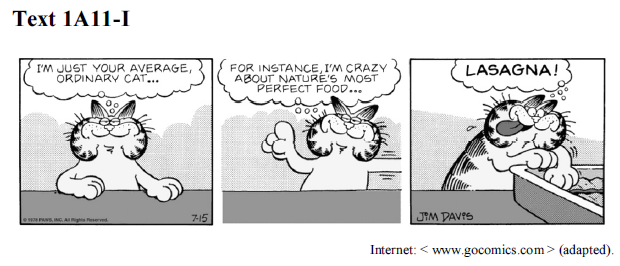
Text 1A2-II
I have often thought how interesting a magazine paper
might be written by any author who would—that is to say, who
could—detail, step by step, the processes by which any one of
his compositions attained its ultimate point of completion. Why
such a paper has never been given to the world, I am much at a
loss to say—but, perhaps, the authorial vanity has had more to do
with the omission than any one other cause. Most writers—poets
in especial—prefer having it understood that they compose by a
species of fine frenzy—an ecstatic intuition—and would
positively shudder at letting the public take a peep behind the
scenes, at the elaborate and vacillating crudities of thought—at
the true purposes seized only at the last moment—at the
innumerable glimpses of idea that arrived not at the maturity of
full view—at the fully-matured fancies discarded in despair as
unmanageable—at the cautious selections and rejections—at the
painful erasures and interpolations—in a word, at the wheels and
pinions—the tackle for scene-shifting—the step-ladders, and
demon-traps—the cock’s feathers, the red paint and the black
patches, which, in ninety-nine cases out of a hundred, constitute
the properties of the literary histrio.
I am aware, on the other hand, that the case is by no
means common, in which an author is at all in condition to
retrace the steps by which his conclusions have been attained. In
general, suggestions, having arisen pell-mell are pursued and
forgotten in a similar manner.
For my own part, I have neither sympathy with the
repugnance alluded to, nor, at any time, the least difficulty in
recalling to mind the progressive steps of any of my
compositions, and, since the interest of an analysis or
reconstruction, such as I have considered a desideratum, is quite
independent of any real or fancied interest in the thing analysed,
it will not be regarded as a breach of decorum on my part to
show the modus operandi by which some one of my own works
was put together. I select The Raven as most generally known. It
is my design to render it manifest that no one point in its
composition is referable either to accident or intuition—that the
work proceeded step by step, to its completion, with the precision
and rigid consequence of a mathematical problem.
Edgar Allan Poe. The Philosophy of Composition, 1846 (adapted)
According to Edgar Allan Poe’s point of view, portrayed in text 1A2-II, behind the scenes of writing,
Car crashes into second floor of Pennsylvania home
A man drove his car into the second floor of a Pennsylvania home on Sunday in what officials say was an "intentional act".
Charges are pending against the driver after police found a grey vehicle sticking out of the side of the house in the city of Lewistown.
Officials have not said how exactly the vehicle made its way to the second floor.
"The pictures speak for themselves", a fire official told the BBC.
Anywhere from one to three people were inside the home at the time of the crash but were not injured, according to Sam Baumgardner, an administrator at the Junction Fire Company, which assisted in the response to the crash.
The driver was able to climb out onto the roof after the crash and was taken to the hospital with injuries, Mr Baumgardner said.
He added that the car likely hit the second floor because of a culvert - a tunnel that carries a stream under a road or railway - on the left side of the house.
The driver "went into the culvert and propelled into the air and landed on the second floor", Mr Baumgardner said.
In a report, Lewistown police said they had determined through an investigation that the crash was "an intentional act".
Officials added that the driver will face charges for the crash.
The BBC has reached out to police for comment.
The fire department said it took about three hours to remove the car from the second floor.
"The crew that was on the rescue definitely had to think outside the box," Mr Baumgardner said.
Rescue crews helped stabilise the house and put a tarp over the hole from the crash because of upcoming storms, the Junction Fire Company said in a post on Facebook.
Internet: BBC News
Na frase “The BBC has reached out to police for comment”, podemos afirmar que a expressão sublinhada significa:
Why Climate Change Could Mean More Delayed Flights
No one enjoys a delayed flight, but as our weather gets warmer, we can expect more of them.
That's according to experts, who say that the heat of the summer might cause more delays.
Bloomberg looked at US data for flight delays at airports in Chicago and New York from June to August in 2022 and from
January to March in 2023. It found that there were more delayed flights in the summer months at both airports.
When the temperature rises above 39 degrees Celsius, things get very difficult for airlines, Bijan Vasigh, a professor at Embry-Riddle Aeronautical University in the US, told Bloomberg.
The air is thinner when it gets hot and that makes it harder for planes to take off. In thinner air there is not as much lift, so more power is needed.
When they need more power, it helps to have a lighter airplane.
That might mean pilots have to make last-minute decisions to reduce the weight on board by dumping fuel, passengers or baggage — meaning the plane will probably be delayed.
The problem gets worse at airports that are at a higher altitude where the air is already thinner, and at airports with short runways, since planes need more space to get up to a high speed.
But thin air is not the only problem. Smoke from wildfires — that have been happening all around the world in the summer of 2023 — can also cause flights to be delayed and canceled.
Of course, the summer is also a busy time when millions of people fly, and weather is not the only cause of delays — but our hotter climate doesn't seem to be helping.
Internet: Engoo
O último parágrafo começa com a expressão "Of course". Assinale a alternativa que apresenta qual das seguintes expressões não é um sinônimo.
Text 1A2-I
Languages are more to us than systems of thought
transference. They are invisible garments that drape themselves
about our spirit and give a predetermined form to all its symbolic
expression. When the expression is of unusual significance, we
call it literature. Art is so personal an expression that we do not
like to feel that it is bound to predetermined form of any sort.
The possibilities of individual expression are infinite, language in
particular is the most fluid of mediums. Yet some limitation there
must be to this freedom, some resistance of the medium.
In great art there is the illusion of absolute freedom. The
formal restraints imposed by the material are not perceived; it is
as though there were a limitless margin of elbow room between
the artist’s fullest utilization of form and the most that the
material is innately capable of. The artist has intuitively
surrendered to the inescapable tyranny of the material, made its
brute nature fuse easily with his conception. The material
“disappears” precisely because there is nothing in the artist’s
conception to indicate that any other material exists. For the time
being, he, and we with him, move in the artistic medium as a fish
moves in the water, oblivious of the existence of an alien
atmosphere. No sooner, however, does the artist transgress the
law of his medium than we realize with a start that there is a
medium to obey.
Language is the medium of literature as marble or bronze
or clay are the materials of the sculptor. Since every language has
its distinctive peculiarities, the innate formal limitations—and
possibilities—of one literature are never quite the same as those
of another. The literature fashioned out of the form and substance
of a language has the color and the texture of its matrix. The
literary artist may never be conscious of just how he is hindered
or helped or otherwise guided by the matrix, but when it is a
question of translating his work into another language, the nature
of the original matrix manifests itself at once. All his effects have
been calculated, or intuitively felt, with reference to the formal
“genius” of his own language; they cannot be carried over
without loss or modification. Croce is therefore perfectly right in
saying that a work of literary art can never be translated.
Nevertheless, literature does get itself translated, sometimes with
astonishing adequacy.
Edward Sapir. Language: an introduction to the study of speech. 1921 (adapted).
The word “oblivious”, in the fragment “oblivious of the existence of an alien atmosphere” (fifth sentence of the second paragraph) is being used, in text 1A2-I, with the same meaning as
Car crashes into second floor of Pennsylvania home
A man drove his car into the second floor of a Pennsylvania home on Sunday in what officials say was an "intentional act".
Charges are pending against the driver after police found a grey vehicle sticking out of the side of the house in the city of Lewistown.
Officials have not said how exactly the vehicle made its way to the second floor.
"The pictures speak for themselves", a fire official told the BBC.
Anywhere from one to three people were inside the home at the time of the crash but were not injured, according to Sam Baumgardner, an administrator at the Junction Fire Company, which assisted in the response to the crash.
The driver was able to climb out onto the roof after the crash and was taken to the hospital with injuries, Mr Baumgardner said.
He added that the car likely hit the second floor because of a culvert - a tunnel that carries a stream under a road or railway - on the left side of the house.
The driver "went into the culvert and propelled into the air and landed on the second floor", Mr Baumgardner said.
In a report, Lewistown police said they had determined through an investigation that the crash was "an intentional act".
Officials added that the driver will face charges for the crash.
The BBC has reached out to police for comment.
The fire department said it took about three hours to remove the car from the second floor.
"The crew that was on the rescue definitely had to think outside the box," Mr Baumgardner said.
Rescue crews helped stabilise the house and put a tarp over the hole from the crash because of upcoming storms, the Junction Fire Company said in a post on Facebook.
Internet: BBC News
In the sentence "The pictures speak for themselves" we can state that:
Car crashes into second floor of Pennsylvania home
A man drove his car into the second floor of a Pennsylvania home on Sunday in what officials say was an "intentional act".
Charges are pending against the driver after police found a grey vehicle sticking out of the side of the house in the city of Lewistown.
Officials have not said how exactly the vehicle made its way to the second floor.
"The pictures speak for themselves", a fire official told the BBC.
Anywhere from one to three people were inside the home at the time of the crash but were not injured, according to Sam Baumgardner, an administrator at the Junction Fire Company, which assisted in the response to the crash.
The driver was able to climb out onto the roof after the crash and was taken to the hospital with injuries, Mr Baumgardner said.
He added that the car likely hit the second floor because of a culvert - a tunnel that carries a stream under a road or railway - on the left side of the house.
The driver "went into the culvert and propelled into the air and landed on the second floor", Mr Baumgardner said.
In a report, Lewistown police said they had determined through an investigation that the crash was "an intentional act".
Officials added that the driver will face charges for the crash.
The BBC has reached out to police for comment.
The fire department said it took about three hours to remove the car from the second floor.
"The crew that was on the rescue definitely had to think outside the box," Mr Baumgardner said.
Rescue crews helped stabilise the house and put a tarp over the hole from the crash because of upcoming storms, the Junction Fire Company said in a post on Facebook.
Internet: BBC News
A expressão "pensar fora da caixa" significa:
Why Climate Change Could Mean More Delayed Flights
No one enjoys a delayed flight, but as our weather gets warmer, we can expect more of them.
That's according to experts, who say that the heat of the summer might cause more delays.
Bloomberg looked at US data for flight delays at airports in Chicago and New York from June to August in 2022 and from
January to March in 2023. It found that there were more delayed flights in the summer months at both airports.
When the temperature rises above 39 degrees Celsius, things get very difficult for airlines, Bijan Vasigh, a professor at Embry-Riddle Aeronautical University in the US, told Bloomberg.
The air is thinner when it gets hot and that makes it harder for planes to take off. In thinner air there is not as much lift, so more power is needed.
When they need more power, it helps to have a lighter airplane.
That might mean pilots have to make last-minute decisions to reduce the weight on board by dumping fuel, passengers or baggage — meaning the plane will probably be delayed.
The problem gets worse at airports that are at a higher altitude where the air is already thinner, and at airports with short runways, since planes need more space to get up to a high speed.
But thin air is not the only problem. Smoke from wildfires — that have been happening all around the world in the summer of 2023 — can also cause flights to be delayed and canceled.
Of course, the summer is also a busy time when millions of people fly, and weather is not the only cause of delays — but our hotter climate doesn't seem to be helping.
Internet: Engoo
What can cause flight delays according to the text:
Text 1A11-II
“Click!” That’s the sound of safety. That’s the sound of survival. That’s the sound of a seat belt locking in place. Seat belts save lives and that’s a fact. That’s why I don’t drive anywhere until mine is on tight. Choosing to wear your seat belt is as simple as choosing between life and death. Which one do you choose? Think about it. When you’re driving in a car, you may be going 100 km/h or faster. That car is zipping down the road. Then somebody ahead of you locks up his or her brakes. You don’t have time to stop. The car that you are in crashes.
Some people think that seat belts are uncool. They think that seat belts cramp their style, or that seat belts are uncomfortable. To them, I say, what’s more uncomfortable? Wearing a seat belt or flying through a car windshield? What’s more uncool? Being safely anchored to a car, or skidding across the road in your jean shorts? Wearing a seat belt is both cooler and more comfortable than the alternatives. Let’s just take a closer look at your choices. If you are not wearing your seat belt, you can hop around the car and slide in and out of your seat easily. That sounds like a lot of fun. But, you are also more likely to die or suffer serious injuries. If you are wearing a seat belt, you have to stay in your seat. That’s no fun. But, you are much more likely to walk away unharmed from a car accident. Hmmm... A small pleasure for a serious pain. That’s a tough choice. I think that I’ll avoid the serious pain.
Internet: <www.agendaweb.com> (adapted).
In text 1A11-II, the pronoun “their” (second sentence of the second paragraph) refers to:
Text 1A2-I
Languages are more to us than systems of thought
transference. They are invisible garments that drape themselves
about our spirit and give a predetermined form to all its symbolic
expression. When the expression is of unusual significance, we
call it literature. Art is so personal an expression that we do not
like to feel that it is bound to predetermined form of any sort.
The possibilities of individual expression are infinite, language in
particular is the most fluid of mediums. Yet some limitation there
must be to this freedom, some resistance of the medium.
In great art there is the illusion of absolute freedom. The
formal restraints imposed by the material are not perceived; it is
as though there were a limitless margin of elbow room between
the artist’s fullest utilization of form and the most that the
material is innately capable of. The artist has intuitively
surrendered to the inescapable tyranny of the material, made its
brute nature fuse easily with his conception. The material
“disappears” precisely because there is nothing in the artist’s
conception to indicate that any other material exists. For the time
being, he, and we with him, move in the artistic medium as a fish
moves in the water, oblivious of the existence of an alien
atmosphere. No sooner, however, does the artist transgress the
law of his medium than we realize with a start that there is a
medium to obey.
Language is the medium of literature as marble or bronze
or clay are the materials of the sculptor. Since every language has
its distinctive peculiarities, the innate formal limitations—and
possibilities—of one literature are never quite the same as those
of another. The literature fashioned out of the form and substance
of a language has the color and the texture of its matrix. The
literary artist may never be conscious of just how he is hindered
or helped or otherwise guided by the matrix, but when it is a
question of translating his work into another language, the nature
of the original matrix manifests itself at once. All his effects have
been calculated, or intuitively felt, with reference to the formal
“genius” of his own language; they cannot be carried over
without loss or modification. Croce is therefore perfectly right in
saying that a work of literary art can never be translated.
Nevertheless, literature does get itself translated, sometimes with
astonishing adequacy.
Edward Sapir. Language: an introduction to the study of speech. 1921 (adapted).
Choose the option in which the fragment “No sooner, however, does the artist transgress the law of his medium than we realize” (last sentence of the second paragraph of text 1A2-I) is correctly rewritten, without changing its meaning or harming its correctness.
Text 1A2-II
I have often thought how interesting a magazine paper
might be written by any author who would—that is to say, who
could—detail, step by step, the processes by which any one of
his compositions attained its ultimate point of completion. Why
such a paper has never been given to the world, I am much at a
loss to say—but, perhaps, the authorial vanity has had more to do
with the omission than any one other cause. Most writers—poets
in especial—prefer having it understood that they compose by a
species of fine frenzy—an ecstatic intuition—and would
positively shudder at letting the public take a peep behind the
scenes, at the elaborate and vacillating crudities of thought—at
the true purposes seized only at the last moment—at the
innumerable glimpses of idea that arrived not at the maturity of
full view—at the fully-matured fancies discarded in despair as
unmanageable—at the cautious selections and rejections—at the
painful erasures and interpolations—in a word, at the wheels and
pinions—the tackle for scene-shifting—the step-ladders, and
demon-traps—the cock’s feathers, the red paint and the black
patches, which, in ninety-nine cases out of a hundred, constitute
the properties of the literary histrio.
I am aware, on the other hand, that the case is by no
means common, in which an author is at all in condition to
retrace the steps by which his conclusions have been attained. In
general, suggestions, having arisen pell-mell are pursued and
forgotten in a similar manner.
For my own part, I have neither sympathy with the
repugnance alluded to, nor, at any time, the least difficulty in
recalling to mind the progressive steps of any of my
compositions, and, since the interest of an analysis or
reconstruction, such as I have considered a desideratum, is quite
independent of any real or fancied interest in the thing analysed,
it will not be regarded as a breach of decorum on my part to
show the modus operandi by which some one of my own works
was put together. I select The Raven as most generally known. It
is my design to render it manifest that no one point in its
composition is referable either to accident or intuition—that the
work proceeded step by step, to its completion, with the precision
and rigid consequence of a mathematical problem.
Edgar Allan Poe. The Philosophy of Composition, 1846 (adapted)
In the third sentence of text 1A2-II, the fragment “shudder at” can be correctly replaced by
Text 1A2-III
In January 1948, before three pistol shots put an end to his
life, Gandhi had been on the political stage for more than fifty
years. He had inspired two generations of Indian patriots, shaken
an empire and sparked off a revolution which was to change the
face of Africa and Asia. To millions of his own people, he was
the Mahatma — the great soul — whose sacred glimpse was a
reward in itself.
By the end of 1947 he had lived down much of the
suspicion, ridicule and opposition which he had to face, when he
first raised the banner of revolt against racial exclusiveness and
imperial domination. His ideas, once dismissed as quaint and
utopian, had begun to strike answering chords in some of the
finest minds in the world. “Generations to come, it may be,”
Einstein had said of Gandhi in July 1944, “will scarcely believe
that such a one as this ever in flesh and blood walked upon
earth.”
Though his life had been a continual unfolding of an
endless drama, Gandhi himself seemed the least dramatic of men.
It would be difficult to imagine a man with fewer trappings of
political eminence or with less of the popular image of a heroic
figure. With his loin cloth, steel-rimmed glasses, rough sandals, a
toothless smile and a voice which rarely rose above a whisper, he
had a disarming humility. He was, if one were to use the famous
words of the Buddha, a man who had “by rousing himself, by
earnestness, by restraint and control, made for himself an island
which no flood could overwhelm.”
Gandhi’s deepest strivings were spiritual, but he did
not — as had been the custom in his country — retire to a cave in
the Himalayas to seek his salvation. He carried his cave within
him. He did not know, he said, any religion apart from human
activity; the spiritual law did not work in a vacuum, but
expressed itself through the ordinary activities of life.
This aspiration to relate the spirit of religion to the
problems of everyday life runs like a thread through Gandhi’s
career: his uneventful childhood, the slow unfolding and the
near-failure of his youth, the reluctant plunge into the politics of
Natal, the long unequal struggle in South Africa, and the
vicissitudes of the Indian struggle for freedom, which under his
leadership was to culminate in a triumph not untinged with
tragedy.
B. R. Nanda. Gandhi: a pictorial biography, 1972 (adapted)
The word “quaint” (second sentence of the second paragraph), in its use in text 1A2-III, means
Car crashes into second floor of Pennsylvania home
A man drove his car into the second floor of a Pennsylvania home on Sunday in what officials say was an "intentional act".
Charges are pending against the driver after police found a grey vehicle sticking out of the side of the house in the city of Lewistown.
Officials have not said how exactly the vehicle made its way to the second floor.
"The pictures speak for themselves", a fire official told the BBC.
Anywhere from one to three people were inside the home at the time of the crash but were not injured, according to Sam Baumgardner, an administrator at the Junction Fire Company, which assisted in the response to the crash.
The driver was able to climb out onto the roof after the crash and was taken to the hospital with injuries, Mr Baumgardner said.
He added that the car likely hit the second floor because of a culvert - a tunnel that carries a stream under a road or railway - on the left side of the house.
The driver "went into the culvert and propelled into the air and landed on the second floor", Mr Baumgardner said.
In a report, Lewistown police said they had determined through an investigation that the crash was "an intentional act".
Officials added that the driver will face charges for the crash.
The BBC has reached out to police for comment.
The fire department said it took about three hours to remove the car from the second floor.
"The crew that was on the rescue definitely had to think outside the box," Mr Baumgardner said.
Rescue crews helped stabilise the house and put a tarp over the hole from the crash because of upcoming storms, the Junction Fire Company said in a post on Facebook.
Internet: BBC News
When the Officials added that the driver will face charges. The underlined sentence means:
Why Climate Change Could Mean More Delayed Flights
No one enjoys a delayed flight, but as our weather gets warmer, we can expect more of them.
That's according to experts, who say that the heat of the summer might cause more delays.
Bloomberg looked at US data for flight delays at airports in Chicago and New York from June to August in 2022 and from
January to March in 2023. It found that there were more delayed flights in the summer months at both airports.
When the temperature rises above 39 degrees Celsius, things get very difficult for airlines, Bijan Vasigh, a professor at Embry-Riddle Aeronautical University in the US, told Bloomberg.
The air is thinner when it gets hot and that makes it harder for planes to take off. In thinner air there is not as much lift, so more power is needed.
When they need more power, it helps to have a lighter airplane.
That might mean pilots have to make last-minute decisions to reduce the weight on board by dumping fuel, passengers or baggage — meaning the plane will probably be delayed.
The problem gets worse at airports that are at a higher altitude where the air is already thinner, and at airports with short runways, since planes need more space to get up to a high speed.
But thin air is not the only problem. Smoke from wildfires — that have been happening all around the world in the summer of 2023 — can also cause flights to be delayed and canceled.
Of course, the summer is also a busy time when millions of people fly, and weather is not the only cause of delays — but our hotter climate doesn't seem to be helping.
Internet: Engoo
When we have delayed flights, we understand that: