


The boldfaced word in the fragments of Text I can be substituted, without change in meaning, by the word in italics in:


In Text II, it’s implied that innovation is the elixir of progress in both Revolutions, but it has its downside because
Questions 31 through 33 refer to the following text.
The IRS Chief Counsel is appointed by the President of
the United States, with the advice and consent of the U.S.
Senate, and serves as the chief legal advisor to the IRS
Commissioner on all matters pertaining to the interpretation,
administration, and enforcement of the Internal Revenue
Code, as well as all other legal matters. Under the IRS
Restructuring and Reform Act of 1998, the Chief Counsel
reports to both the IRS Commissioner and the Treasury
General Counsel.
Attorneys in the Chief Counsel’s Office serve as lawyers for
the IRS. They provide the IRS and taxpayers with guidance
on interpreting Federal tax laws correctly, represent the
IRS in litigation, and provide all other legal support required
to carry out the IRS mission.
Chief Counsel received 95,929 cases and closed
94,323 cases during fiscal year 2012. Of the new cases
received, and cases closed, the majority related to tax law
enforcement and litigation, including Tax Court litigation;
collection, bankruptcy, and summons advice and litigation;
Appellate Court litigation; criminal tax; and enforcement
advice and assistance.
In Fiscal Year 2012, Chief Counsel received 31,295
Tax Court cases involving taxpayers contesting an IRS
determination that they owed additional tax. The total
amount of tax and penalty in dispute at the end of the fiscal
year was almost $6.6 billion.
(Source: Internal Revenue Service Data Book, 2012.)
During fiscal year 2012, the Chief Counsel’s office succeeded in
Questions 39 and 40 refer to the following text.
Customs enforcement is concerned with the protection of
society and fighting trans-national organized crime based
on the principles of risk management. In discharging
this mandate, Customs compliance and enforcement
services are involved in a wide range of activities relating
to information and intelligence exchange, combating
commercial fraud, counterfeiting, the smuggling of highly
taxed goods (especially cigarettes and alcohol), drug
trafficking, stolen motor vehicles, money laundering,
electronic crime, smuggling of arms, nuclear materials,
toxic waste and weapons of mass destruction. Enforcement
activities also aim to protect intellectual and cultural
property and endangered plants and animal species.
In order to assist its Members improve the effectiveness of
their enforcement efforts and achieve a balance between
control and facilitation, the World Customs Organisation
has developed a comprehensive technical assistance
and training programmes. In addition, it has established
Regional Intelligence Liaison Offices (RILOs) that are
supported by a global database, the Customs Enforcement
Network (CEN), to facilitate the exchange and use of
information.
The WCO has also developed instruments for international
co-operation in the form of the revised Model Bilateral
Agreement (MBA); the Nairobi Convention, which provides
for mutual administrative assistance in the prevention,
investigation and repression of Customs offences; and
the Johannesburg Convention, which provides for mutual
administrative assistance in Customs matters. The WCO’s
Customs Control and Enforcement programme therefore
aims to promote effective enforcement practices and
encourage co-operation among its Members and with its
various competent partners and stakeholders.
(Source: http://www.wcoomd.org/en/topics/enforcement-and-compliance/
overview.aspx, retrieved on 12 March 2014.)
The text explains that the mandate of the World Customs Organisation comprises both
INSTRUCTION: Choose the CORRECT alternative to answer questions 17 to 20, according to TEXT 1.
TEXT 1

The word "computer" was first recorded as being used in 1613 and was originally used to describe a human
who performed calculations or computations. The definition of a computer remained the same until the end
of the 19th century when people began to realize machines never get tired and can perform calculations much
faster and more accurately than any team of human computers ever could.
In 1822, Charles Babbage began developing the Difference Engine, which was considered to be the first
automatic computing engine. It was capable of computing several sets of numbers and making hard copies of the
results. Unfortunately, because of funding he was never able to complete a full-scale functional version of this
machine. In June of 1991, the London Science Museum completed the Difference Engine Nº 2 for the bicentennial
year of Babbage's birth and later completed the printing mechanism in 2000.
Fonte: http://www.computerhope.com/issues/ch000984.htm Acesso em: 15/10/2013
The word “computer" was first used in the ___ century.
INSTRUCTION: Choose the CORRECT alternative to answer questions 17 to 20, according to TEXT 1.
TEXT 1

The word "computer" was first recorded as being used in 1613 and was originally used to describe a human
who performed calculations or computations. The definition of a computer remained the same until the end
of the 19th century when people began to realize machines never get tired and can perform calculations much
faster and more accurately than any team of human computers ever could.
In 1822, Charles Babbage began developing the Difference Engine, which was considered to be the first
automatic computing engine. It was capable of computing several sets of numbers and making hard copies of the
results. Unfortunately, because of funding he was never able to complete a full-scale functional version of this
machine. In June of 1991, the London Science Museum completed the Difference Engine Nº 2 for the bicentennial
year of Babbage's birth and later completed the printing mechanism in 2000.
Fonte: http://www.computerhope.com/issues/ch000984.htm Acesso em: 15/10/2013
The main function of text 1 is to
INSTRUCTION: Choose the CORRECT alternative to answer question 24, according to TEXT 3.
TEXT 3
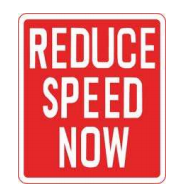
Fonte: http://commons.wikimedia.org/wiki/File:Singapore_Road_Signs_-_Warning_Sign_-_Slow_down.svg Acesso em: 15/10/2013.
The road sign above means that you _____ reduce speed.

According to Text I, the statement “OECD Europe and OECD Asia Pacific are expected to see a lesser contraction than a year earlier” (lines 8-10) implies that the oil demand in those countries
In the fragment of Text I “Less field maintenance in the North Sea and easing geopolitical tensions could also add further barrels in the coming two quarters." (lines 31-33), the expression easing geopolitical tensions means geopolitical tensions that are
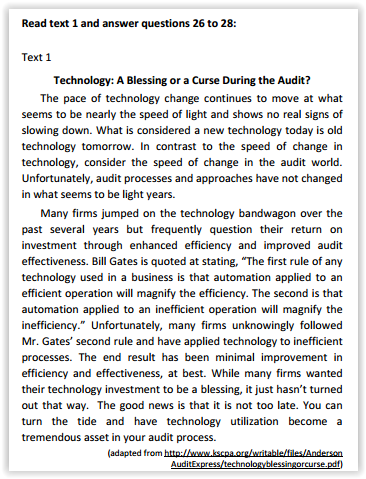
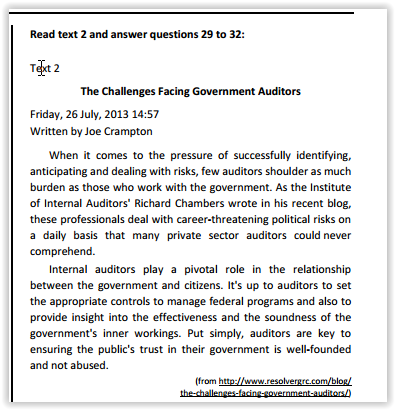
When the author qualifies the role of auditors as “pivotal”, he means it is:
Which alternative contains a correct correspondence of meaning?
The correct opposites for the words “hot” and “waste” are respectively:
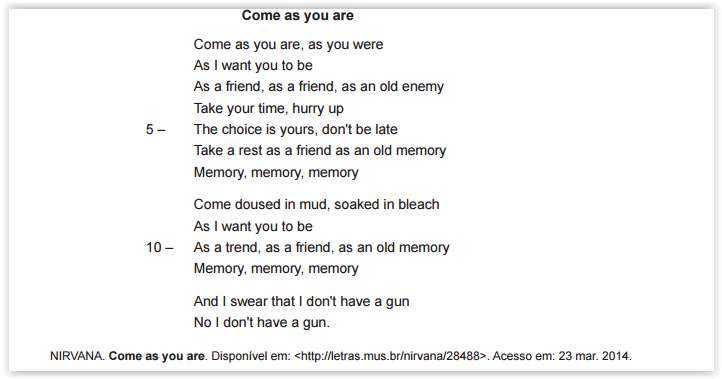
O autor dessa canção dirige-se às pessoas em geral, enfatizando que elas se apresentem e sejam aceitas como realmente são, sem quaisquer restrições.