
English for Specific Purposes teaching often takes, as a point of departure, the analysis
and description of language systems. Basturkmen (2006) examines three language
systems evident in ESP teaching and research – grammatical structures, core vocabulary,
and patterns of text organization.
According to her view and analysis, choose the CORRECT alternative.
English for Business Purposes (or Business English) is an area of great activity and
growth in ESP. Considering what was postulated by Dudley-Evans & St John (1998),
which of the following alternatives DOESN'T present a characteristic of Business English:
Analyze the following statements about evaluation methods in ESP. Consider the
information provided according to its correctness, and then choose the CORRECT
alternative.
I. Questionnaires are generally more wide ranging than checklists and, as they are used
for quantitative information, they need careful construction.
II. Analysis of authentic spoken and written texts, and structured interviews are useful
methods for evaluation.
III. Record keeping includes teacher records of what actually happened in lessons.

Consider the following information about needs analysis regarding its correctness. Then,
choose the CORRECT alternative.
I. Needs analysis can be seen as the corner stone of ESP and it can lead to a very
focused course.
II. The concept of needs analysis hasn't changed since the 1960's.
III. Teachers should study available literature before conducting needs analysis because
the information obtained from clients or students will only be as good as the questions
asked and the analysis of the answers.
IMF's new head economist is imaginative realist
By Edward Hadas
July 21, 2015
What the International Monetary Fund needs most in its economic counsellor is imagination and realism. With Maurice
Obstfeld, who will take over the job from Olivier Blanchard in September, it has both.
Of course, the distinguished Berkeley professor, member of the U.S. president's Council of Economic Advisers and leading
textbook author has the needed technical skills. But conventional academic excellence is not enough to guide the international lender
as it negotiates the intricate politics of the apparently endless Greek crisis. Nor can the old dogma deal with the greatest contemporary
challenge to steady economic development: global financial excess.
Blanchard already moved the IMF well away from its former identification with the Washington Consensus, which was based
on an exaggerated confidence in free markets. His suggestion that the universally targeted inflation rate of 2 percent might be too low
was highly unorthodox. Obstfeld is likely to go further in the same direction.
http://blogs.reuters.com/breakingviews/2015/07/21/imfs-new-head-economist-is-imaginative-realist/
Na expressão: “...as it negotiates the intricate politics…", a palavra sublinhada se refere a:
IMF's new head economist is imaginative realist
By Edward Hadas
July 21, 2015
What the International Monetary Fund needs most in its economic counsellor is imagination and realism. With Maurice
Obstfeld, who will take over the job from Olivier Blanchard in September, it has both.
Of course, the distinguished Berkeley professor, member of the U.S. president's Council of Economic Advisers and leading
textbook author has the needed technical skills. But conventional academic excellence is not enough to guide the international lender
as it negotiates the intricate politics of the apparently endless Greek crisis. Nor can the old dogma deal with the greatest contemporary
challenge to steady economic development: global financial excess.
Blanchard already moved the IMF well away from its former identification with the Washington Consensus, which was based
on an exaggerated confidence in free markets. His suggestion that the universally targeted inflation rate of 2 percent might be too low
was highly unorthodox. Obstfeld is likely to go further in the same direction.
http://blogs.reuters.com/breakingviews/2015/07/21/imfs-new-head-economist-is-imaginative-realist/
A ideia defendida por Olivier Blanchard, que vai contra os padrões tradicionais estabelecidos pelo FMI, refere-se ao fato de que:
INSTRUCTION: Choose the CORRECT alternative to answer questions 17 to 20, according to TEXT 1.
TEXT 1

The word "computer" was first recorded as being used in 1613 and was originally used to describe a human
who performed calculations or computations. The definition of a computer remained the same until the end
of the 19th century when people began to realize machines never get tired and can perform calculations much
faster and more accurately than any team of human computers ever could.
In 1822, Charles Babbage began developing the Difference Engine, which was considered to be the first
automatic computing engine. It was capable of computing several sets of numbers and making hard copies of the
results. Unfortunately, because of funding he was never able to complete a full-scale functional version of this
machine. In June of 1991, the London Science Museum completed the Difference Engine Nº 2 for the bicentennial
year of Babbage's birth and later completed the printing mechanism in 2000.
Fonte: http://www.computerhope.com/issues/ch000984.htm Acesso em: 15/10/2013
Write True (T ) or False (N ). ( ) The meaning of a computer changed a lot from 1613 to the 19th century. ( ) Only after the 19th century it was understood people calculate less quickly than machines. ( ) An updated version of the first automatic computer can be found at the London Science Museum.
INSTRUCTION: Choose the CORRECT alternative to answer questions 21 to 23, according to TEXT 2.
TEXT 2

Food engineering is the application of engineering principles to the storage, processing and distribution of
food materials and _____ bio-products. It requires a sound engineering education, as well as fundamental training
in chemistry and food science.
Food Engineers can make valuable contributions in various capacities of food chain such as design of processing,
handling, packaging and storage equipment and systems; scale-up of prototype food processes, machinery,
and equipment; product/process research and development; regulation and protection of the public health; and
engineering and technical Sales.
Fonte: http://baen.tamu.edu/foodengineering/FEngr/FEngr.html Acesso em: 15/10/2013
The correct word to fill in the space provided in “food materials and ____ bio-products.” from text 2 is
INSTRUCTION: Choose the CORRECT alternative to answer questions 17 to 20, according to TEXT 1.
TEXT 1

The word "computer" was first recorded as being used in 1613 and was originally used to describe a human
who performed calculations or computations. The definition of a computer remained the same until the end
of the 19th century when people began to realize machines never get tired and can perform calculations much
faster and more accurately than any team of human computers ever could.
In 1822, Charles Babbage began developing the Difference Engine, which was considered to be the first
automatic computing engine. It was capable of computing several sets of numbers and making hard copies of the
results. Unfortunately, because of funding he was never able to complete a full-scale functional version of this
machine. In June of 1991, the London Science Museum completed the Difference Engine Nº 2 for the bicentennial
year of Babbage's birth and later completed the printing mechanism in 2000.
Fonte: http://www.computerhope.com/issues/ch000984.htm Acesso em: 15/10/2013
The word “computer” was first used in the ___ century.
Complete the sentence (use the present perfect): Where’s the book I gave you? What _____________ with it?
The passive form of the sentence “The international Court of Hague rejected an attempt by New Zealand to stop further..” is:
Complete the sentence: That milk will leave a __________ in the carpet.
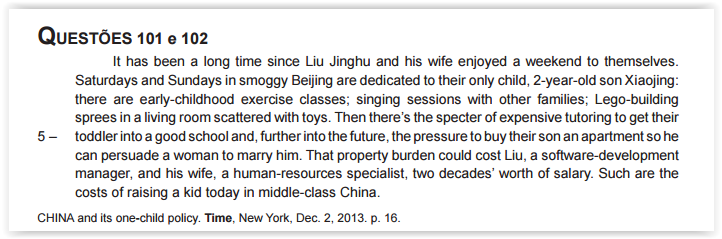
O casal de chineses sabe que, no futuro, terá de arcar com a compra de um apartamento para o filho, a fim de que ele possa conseguir uma esposa.
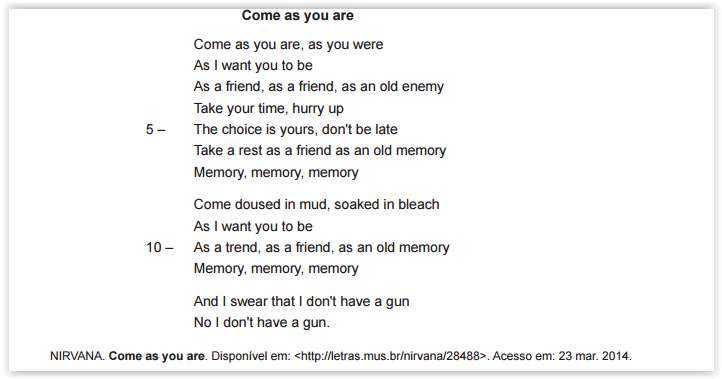
Nos dois últimos versos da canção – “And I swear that I don’t have a gun / No I don’t have a gun”–, o autor lamenta o fato de não possuir uma arma.