
Attention: Read the text and answer questions 30 to 33.
Money issues aren't romantic, but they should be discussed before a wedding
By Carolyn Hax Hi, Carolyn: So, I am getting married in a few months and I've been struggling with a question: How much financial information should a couple share pre-wedding? Recently my fiancé told me that an old creditor started garnishing a portion of his paycheck. I was shocked that his finances were in such a bad state. He has always been private about money, but I didn't care much since I make my own living anyway. I'm just wondering if we need to write out all our debts and share them with each other before marriage. If so, how do I approach this topic? Anonymous You tell him the garnished paycheck surprised you, and you think it's important that both of you share full financial information − including credit scores − then fully discuss your philosophies and approaches to money. This is critical given not just his neglected debt, but also your casual attitude toward his being "private about money." If he won't share, don't marry. Seriously. And if he does share what amounts to a real mess, then postpone the wedding until he sorts himself out. This isn't about your ability to support yourself, though that helps. It's about the financial implications of the legal knot you're about to tie. Unromantic, sure, but losing a home/car, taking second or third jobs, never having a vacation and winding up in bankruptcy are all profoundly unromantic as well. (Adapted form http://www.washingtonpost.com/lifestyle/style/mone...)
According to the text, Carolyn
Attention: Read the text and answer questions 34 to 40.
Our Plugged-in Summer
By BRUCE FEILER
I [TO SET OUT] to spend my summer vacation online. A few things conspired to give me the idea. The first was the insistent finger wagging one now encounters that the only way to spend quality time with one's children is to disengage from technology. The same day, my brother sent along a link for a new app (leafsnap) that allows users to identify trees by submitting photos of leaves. What a smart way to juice that nature walk, I thought. The next day I saw a Twitter message from Pierre Omidyar (@pierre), the eBay founder, in which he attached a photo and asked, "What is the name of this purple and white flower bush?" Seconds later he had his answer: lilac. Then my sister wrote to ask how she could identify the bird building a nest on her deck. "Take a picture and put it on Facebook," I said. "You'll have an answer within the hour." She bet me it wouldn't work, but within 19 minutes two friends had confirmed it was a Carolina wren. I concocted a scheme. During weekends this summer, I would pursue the opposite of an unplugged vacation: I would check screens whenever I could. Not in the service of work, but in the service of play. I would crowd-source new ideas for car games and YouTube my picnic recipes. I would test the prevailing wisdom that the Internet spoils all the fun. With back-to-school fast approaching, here's my report. For starters, the Web supplied an endless font of trivia and historical tidbits to enliven our days. I learned that a great debate still rages over who was the "Benedict" in eggs Benedict; that ancient mythologists believed fish were so afraid of the ospreys that they turned up their bellies in surrender; and that care packages like the one we sent my nephew at camp had their origins feeding starving Europeans in World War II. Online videos are another boon to summer. When my 6-year-old daughters were upset that we didn't awaken them at midnight to watch a brief light show on the Eiffel Tower, a quick trip to YouTube did the trick. My father used seaturtle.org to teach my girls how sea turtles emerge from the Atlantic near our home on Tybee Island, Ga., and lay eggs. Injured turtles are implanted with G.P.S. devices, allowing them to be tracked online. One surprising way that being plugged in improved our vacations was using newfangled resources to solve oldfangled problems. Bugs, for one. I used the Internet to find a home remedy for the slugs eating my begonias (broken eggshells). The Web also helped give us the feeling that we saw people more than we did. While it's fashionable to complain that we're overly connected, I still found an occasional, virtual interaction with a friend or family member to be as pleasant as running into them on the beach. I texted with my 12-year-old nephew about geocaching when we get together. My kids Skyped with my parents about learning to swim. And our devices were lifesavers when my daughter Tybee took a spill and had to be hurried to the hospital for stitches. A friend who took care of Tybee's twin, Eden, e-mailed us a photo of her noshing on pizza to assure us she was fine. When Tybee got nervous, the doctor asked her what movies she should download on her iPad for her son. And just before the procedure, I received a heartwarming text: "Dear Tybee, you are such a brave girl, love Eden."
(Adapted from http://www.nytimes.com/2011/08/14/fashion/this-lif...)
O texto acima é do tipo
Attention: Read the text and answer questions 34 to 40.
Our Plugged-in Summer
By BRUCE FEILER
I [TO SET OUT] to spend my summer vacation online. A few things conspired to give me the idea. The first was the insistent finger wagging one now encounters that the only way to spend quality time with one's children is to disengage from technology. The same day, my brother sent along a link for a new app (leafsnap) that allows users to identify trees by submitting photos of leaves. What a smart way to juice that nature walk, I thought. The next day I saw a Twitter message from Pierre Omidyar (@pierre), the eBay founder, in which he attached a photo and asked, "What is the name of this purple and white flower bush?" Seconds later he had his answer: lilac. Then my sister wrote to ask how she could identify the bird building a nest on her deck. "Take a picture and put it on Facebook," I said. "You'll have an answer within the hour." She bet me it wouldn't work, but within 19 minutes two friends had confirmed it was a Carolina wren. I concocted a scheme. During weekends this summer, I would pursue the opposite of an unplugged vacation: I would check screens whenever I could. Not in the service of work, but in the service of play. I would crowd-source new ideas for car games and YouTube my picnic recipes. I would test the prevailing wisdom that the Internet spoils all the fun. With back-to-school fast approaching, here's my report. For starters, the Web supplied an endless font of trivia and historical tidbits to enliven our days. I learned that a great debate still rages over who was the "Benedict" in eggs Benedict; that ancient mythologists believed fish were so afraid of the ospreys that they turned up their bellies in surrender; and that care packages like the one we sent my nephew at camp had their origins feeding starving Europeans in World War II. Online videos are another boon to summer. When my 6-year-old daughters were upset that we didn't awaken them at midnight to watch a brief light show on the Eiffel Tower, a quick trip to YouTube did the trick. My father used seaturtle.org to teach my girls how sea turtles emerge from the Atlantic near our home on Tybee Island, Ga., and lay eggs. Injured turtles are implanted with G.P.S. devices, allowing them to be tracked online. One surprising way that being plugged in improved our vacations was using newfangled resources to solve oldfangled problems. Bugs, for one. I used the Internet to find a home remedy for the slugs eating my begonias (broken eggshells). The Web also helped give us the feeling that we saw people more than we did. While it's fashionable to complain that we're overly connected, I still found an occasional, virtual interaction with a friend or family member to be as pleasant as running into them on the beach. I texted with my 12-year-old nephew about geocaching when we get together. My kids Skyped with my parents about learning to swim. And our devices were lifesavers when my daughter Tybee took a spill and had to be hurried to the hospital for stitches. A friend who took care of Tybee's twin, Eden, e-mailed us a photo of her noshing on pizza to assure us she was fine. When Tybee got nervous, the doctor asked her what movies she should download on her iPad for her son. And just before the procedure, I received a heartwarming text: "Dear Tybee, you are such a brave girl, love Eden."
(Adapted from http://www.nytimes.com/2011/08/14/fashion/this-lif...)
Segundo o texto,
Choose the best phrase to complete the questions by matching the two columns. 1.Can I have ( ) to talk about the problem? 2.Would you like ( ) a word with you now? 3.Do you mind ( ) talk to your boss first? 4.Why don’t you ( ) giving him this message please? What is the correct sequence for the phrases on the right-hand side?
Attention: Read the three job announcements below and answer questions 49-52.

For the position of a software architect at the Guardian News & Media Digital Development, the ad specifies that the candidate should
Attention: For questions 53-60, read the text below and decide which answer (A, B, C or D) best fits each gap.
Saving energy: it starts at home
We already know the fastest, 53 expensive way to slow climate change: use less energy. With a little effort, and not 54 money, most of us could reduce our energy diets by 25 percent or more − 55 the Earth a favor while also helping our pocketbooks. So what's holding us back? Scientists have reported recently that the world is heating up even faster 56 predicted only a few years 57 , and that the consequences could be severe if we don't 58 reducing emission of carbon dioxide and other greenhouse gases that are trapping heat in our atmosphere. But what can we 59 about it as individuals? Will our efforts really 60 any difference?
(Extracted from the National Geographic Magazine, March 2009)
Quando se compara o átomo neutro de ferro (Fe) com o íon Fe3+, ambos correspondentes ao isótopo de número de massa 56, observa-se que o íon possui três
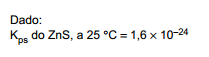
Uma solução contém íons zinco, Zn2+(aq ), em concentração 0,01 mol/L. Para que a solução fique saturada a 25 °C, sem
precipitado de ZnS (s ), a concentração do ânion sulfeto, S2- (aq ), deve ser igual a
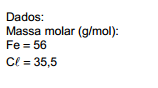
A porcentagem em massa de ferro, no cloreto ferroso, é, aproximadamente,
São exemplos de transformações químicas:
A sacarose, ou açúcar comum, se dissolve facilmente em água porque
Para demonstrar o funcionamento do dispositivo de segurança conhecido como airbag, um professor realizou uma reação
química e encheu de gás um balão de aniversário com capacidade de 2 litros. A reação química testada foi a seguinte:

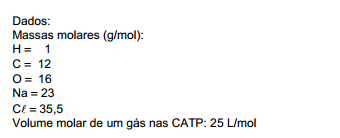
Para encher o balão em sua capacidade máxima nas CATP, foi necessário reagir com o ácido uma quantidade mínima de
bicarbonato, em gramas, de
Atenção: A tabela a seguir se refere às questões de números 49 a 51.
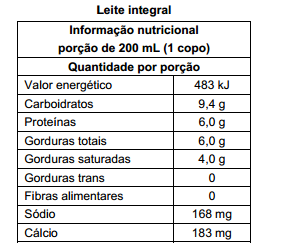
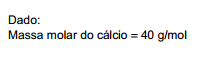
A concentração em mol.L-1 de cálcio nesse leite corresponde a
O modelo de átomo nuclear de Rutherford foi sugerido a partir de resultados de experimentos que conflitaram com
Um corpo é lançado verticalmente para baixo, de uma altura de 60 m em relação ao solo, com velocidade inicial de 8 m/s. Desprezando a resistência do ar, a altura do corpo, em relação ao solo, 2s após o lançamento, em metros, vale Dado: g = 10 m/s²