
O cacófato é uma construção em que a união da sílaba final de um vocábulo com a sílaba inicial do vocábulo seguinte provoca o aparecimento de um som desagradável, ridículo ou grosseiro, como ocorre na seguinte frase:
Além do controle dos gastos com pessoal, a LRF disciplina as operações de crédito pleiteadas pelos entes públicos.
A respeito do tema, é correto afirmar que
Text I
Office Culture
Companies are clawing to bring back pre-pandemic perks and that 'family'
feeling – but employees want something more tangible.
Many employers are calling employees back into offices, trying
to restore the workplace of pre-pandemic days. Along with filling
seats, they're also looking to bring back another relic: office
culture.
Pre-2020, office culture was synonymous with the 'cool' office:
think places to lounge, stocked pantries and in-office happy hours
that went all out; or luxe retreats and team-building exercises
meant to foster the feeling of 'family'. In past years, these perks
drew many workers to the office – in some cases, entire companies
defined themselves by their office cultures.
The world of work looks and feels entirely different than just a
few years ago – yet many companies are still intent on recreating
the office cultures workers left behind as they abandoned their
desks in 2020. While these companies are making some gestures
to adapt – for instance, redesigning spaces to accommodate new
preferences and hybrid-work habits – many are still set on bringing
back what lured in workers before the pandemic.
Yet swaths of employees simply aren't interested in going
backward. Instead of trust-falls and cold brew on tap, employees
are demanding flexible work, equitable pay and a focus on
humanity in the workplace that transcends the perks they sought
years earlier.
Workers' shifting priorities are a natural consequence of the
Covid-19 pandemic, says Georgina Fraser, head of human capital
for global commercial real-estate firm CBRE. "The pandemic gave
us autonomy in a way that we haven't had previously," she says.
"It gave us the opportunity to choose how we structured our
working days." And now that workers have experienced that level of work-life
balance, they won't settle for less. Fraser adds: "Post-pandemic,
we saw a resurgence of people being very vocal about what they
wanted and needed, not just from office culture, but from the
wider world."
Now, she says, workers aren't shy about "wanting to be seen
as a whole human – and that filters down to their physical location,
how [employers] manage them, what support they receive and
how [employers] integrate technologies between home and office
in order to support them".
One major factor in this changing attitude is that many
employees feel office culture simply isn't applicable in a remote and hybrid-first world, where the physical office can feel
superfluous. Now that the workplace doesn't serve as the culture
hub it once did, "companies have really struggled to redefine the
role of the office", says Lewis Beck, CBRE's head of workplace for
Europe. Office culture that was once meant to get employees
excited doesn't have the same pull when workplaces are only one third full.
Adapted from: https://www.bbc.com/worklife/article/20240229-office-culture-is dead
Trust-falls (4th paragraph) are group activities aimed at
Uma aplicação corporativa registra os logs de acesso em um
arquivo chamado “Log_Acesso” na pasta “/var/log/app/” de um
servidor Linux com IPv4 192.168.0.1.
A seguir é apresentado um trecho do arquivo de logs, onde é
possível verificar a forma e as informações que são armazenadas
por esta aplicação.
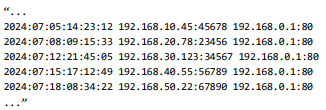
O administrador de rede dessa empresa deseja identificar os IP
com maior frequência de acesso a essa aplicação. Para realizar
essa tarefa, executou o comando abaixo no terminal do servidor
desta aplicação.
echo "$(cat /var/log/app/Log_Acesso)" | grep
"192.168.0.1:80" | cut -d' ' -f2 | cut -d':' -f1 | sort
| uniq -c | sort -nr
Sobre o comando realizado pelo administrador de rede, analise as
afirmativas a seguir.
I. O comando “grep “192.168.0.1:80”” filtra as linhas do log que
contêm a string “192.168.0.1:80”, ou seja, linhas que registram
acessos ao IP de destino 192.168.0.1, na porta 80.
II. O comando “cut -d' ' -f2” usa o comando “cut” para dividir cada
linha filtrada pelo delimitador de espaço “ ”, e extrai o segundo
campo. Este campo contém o endereço IPv4 de origem e a
respectiva porta.
III. O comando “sort -nr” ordena os endereços IPv4 de origem em
ordem alfabética.
Está correto o que se afirma em
O orçamento público no Brasil é um instrumento fundamental para o planejamento e a administração dos recursos financeiros do
Estado, visando atender às necessidades da sociedade e fomentar o desenvolvimento econômico e social do país.
Com relação ao orçamento público, analise as afirmativas a seguir.
I. A elaboração de propostas orçamentárias envolve a
consolidação, pelo Poder Executivo, do Projeto de Lei
Orçamentária Anual (PLOA), abrangendo as propostas
orçamentárias dos demais Poderes, seguida do envio ao Poder
Legislativo para apreciação.
II. O PLOA, uma iniciativa do Presidente da República, estima as
receitas e fixa as despesas para o exercício financeiro seguinte,
com estrutura e nível de detalhamento definidos pela Lei de
Diretrizes Orçamentárias (LDO) do exercício.
III. A Lei Orçamentária Anual (LOA) suprime os orçamentos fiscal,
da seguridade social e de investimento das estatais.
Está correto o que se afirma em