

Bohn (2013, p. 83 and 90) argues that in Brazil teacher identity has been strongly influenced by
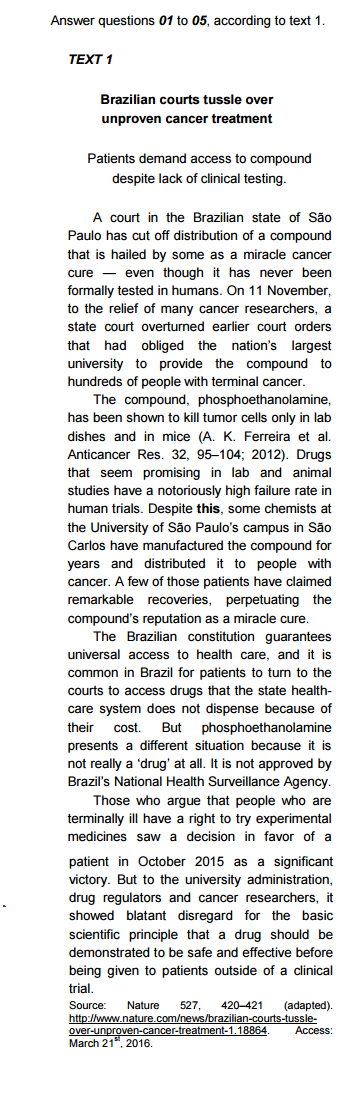
According to the text, drug regulators and cancer researchers in Brazil are
“The International Phonetic Alphabet (IPA)
was established in 1886 in Paris. The aim of
the IPA is to promote the scientific study of
phonetics and the various practical
applications of that science. In furtherance of
this aim, the IPA provides the academic
community world-wide with a notational
standard for the phonetic representation of
all languages. The latest version of the IPA
Alphabet was published in 2005”
Source:
https://www.internationalphoneticassociation.org
(Adapted). Access: March 21st, 2016
The phonetic transcription below corresponds to
American English (based on the open Carnegie Mellon
University Pronouncing Dictionary).
According to IPA, the phonetic transcription
above corresponds to
Identify the alternative in which the plural form is INCORRECT.
The word in bold type is NOT the head or primary element in the nominal group in the sentence
The ING ending word is used as an adjective in the sentence
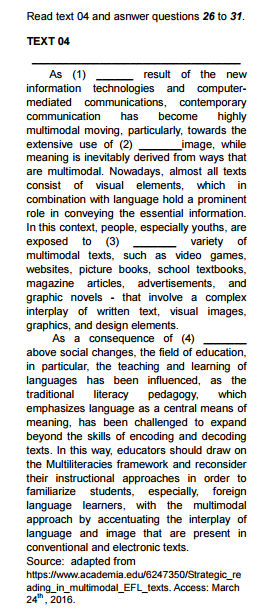
According to what is developed throughout the text 04, what is the best title to it?
I’ve just ran into your sister on the mall.
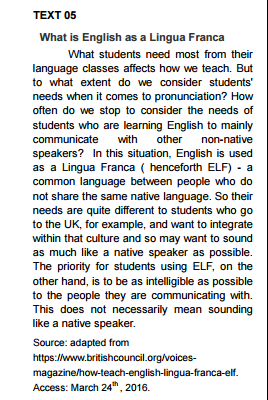
The same type of underlined comparative of the excerpt taken from the text 05 "The priority for students using ELF, on the other hand, is to be as intelligible as possible to the people they are communicating with." (lines 16 to 18), is:
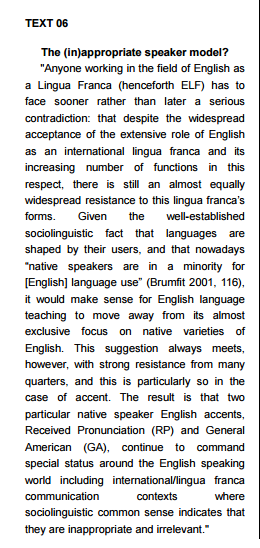
The word "resistance" (line 07) in the text 06, is formed by resist + the suffix – ance. Another word that can be formed with the suffx -ance is

In the quotation "...and want to integrate within that culture and so may want to sound as much like a native speaker as possible.", taken from the text 07, the modal verb could be changed , maintaining the idea expresses, by:

Judge the following items according to the text CB3A1AAA.
Software construction professionals must be acquainted with concurrency quickly.
Nos Referenciais Curriculares para a Rede Pública de Niterói (2010), pode-se encontrar um norteamento pedagógico em direção à busca da construção de uma identidade aberta à pluralidade cultural. Dentro desta lógica, o ensino da língua inglesa nas escolas deve buscar:
As questões 06 a 10 referem-se ao Texto 2.
Texto 2
Multicultural Education in Your Classroom
By: E.K. Garcia
America has always been referred to as a melting
pot, but ideally, it's a place where we strive to invite
everyone to celebrate exactly who they are. As the
US. population is becoming increasingly diverse and
technology makes the world feel increasingly
smaller, it is time to make every classroom a
multicultural classroom.
Multicultural education is more than celebrating
Cinco de Mayo with tacos and piñatas or reading
the latest biography of Martin Luther King Jr. It is an
educational movement built on basic American
values such as freedom, justice, opportunity, and
equality. It is a set of strategies aimed to address
the diverse challenges experienced by rapidly
changing U.S. demographics. And it is a beginning
step to shifting the balance of power and privilege
within the education system.
The goals of multicultural education include creating
a safe, accepting and successful learning
environment for all, increasing awareness of global
issues, strengthening cultural consciousness,
strengthening intercultural awareness, teaching
students that there are multiple historical
perspectives, encouraging critical thinking and
preventing prejudice and discrimination.
According to the National Association for
Multicultural Education (NAME), the advantages of
multicultural education are helping students develop
positive self-image, offering students an equitable
educational opportunity, allowing multiple
perspectives and ways of thinking, combating
stereotypes/prejudicial behavior and teaching
students to critique society in the interest of social
justice.
Contrary to popular belief, multicultural education is
more than cultural awareness, but rather an initiative
to encompass all under-represented groups (people
of color, women, people with disabilities, etc) and to
ensure curriculum and content including such
groups is accurate and complete.
Most curriculums focus more on North America and
Europe than any other region. Most students have
learned about genocide through stories of the
Holocaust, but do they know that hundreds of
thousands of people are being killed in places like
Darfur and Rwanda? Despite our close proximity to
Latin America, American schools typically spend
little time reading Latin American literature or
learning about the culture and history.
_______, multicultural education is most successful
when implemented as a schoolwide approach with
reconstruction of not only curriculum, but also
organizational and institutional policy. Educators
must be aware, responsive and embracing of the
diverse beliefs, perspectives and experiences. They
must also be willing and ready to address issues of
controversy.
These issues include, but are not limited to, racism,
sexism, religious intolerance, classism, ageism, etc.
(Adapted from http://www.teachhub.com/multiculturaleducation-your-classroom
Accessed on 21 April 2016)
In the fragment, “Despite our close proximity to Latin America, American schools typically spend little time reading Latin American literature or learning about the culture and history.”, the underlined term can be substitute by:
As questões 13 a 15 referem-se ao Texto 4.
Texto 4
(…) In describing methods, the difference between a
philosophy of language teaching at the level of
theory and principles, and a set of derived
procedures for teaching a language, is central. In an
attempt to clarify this difference, a scheme was
proposed by the American applied linguist Edward
Anthony in 1963. He identified three levels of
conceptualization and organization, ________ he
termed approach, method, and technique.
The arrangement is hierarchical. The
organizational key is that techniques carry out a
method which is consistent with an approach . ..
An approach is a set of correlative
assumptions dealing with the nature of language
teaching and learning. An approach is axiomatic.
It describes the nature of the subject matter to be
taught. .. .
... Method is an overall plan for the
orderly presentation of language material, no part
of which contradicts, and all of which is based
upon, the selected approach. An approach is
axiomatic, a method is procedural. Within one
approach, there can be many methods . ..
... A technique is implementational - that
which actually takes place in a classroom. It is a
particular trick, stratagem, or contrivance used to
accomplish an immediate objective. Techniques
must be consistent with a method, and therefore
in harmony with an approach as well. (Anthony
1963:63-7)
According to Anthony's model, approach is the level
at which assumptions and beliefs about language
and language learning are specified; method is the
level at ________ theory is put into practice and at
_____ choices are made about the particular skills
to be taught, the content to be taught, and the order
in ______ the content will be presented; technique
is the level at _____ classroom procedures are
described.
(RICHARDS, J; ROGERS, T; SWAN, M. (1999) Approaches and
Methods in Language Teaching. Cambridge: CUP. 15th edition)
Observe the fragments below: “He identified three levels of conceptualization and organization, _________ he termed approach, method, and technique.” “…method is the level at ________ theory is put into practice and at _____ choices are made about the particular skills to be taught, the content to be taught, and the order in ______ the content will be presented; technique is the level at _____ classroom procedures are described.” The best sequence to fill in the blanks in the following sentences is: