
According to the last paragraph, Portland’s fire chief believes that
How cities can better prevent fires

August 29, 2018
America’s deadliest building fire for more than a decade struck Oakland, California, on December 2nd 2016, killing 36 people attending a dance party in a warehouse that had become a cluttered artist collective. The disaster highlights an open secret: many cities lack resources to inspect for fire risk all the structures that they should. Even though the Oakland building had no fire sprinklers and at least ten people lived there illegally, no inspector had visited in about 30 years. How might cities make better use of the inspectors they do have?
A handful of American cities have begun to seek help from a new type of analytics software. By crunching diverse data collected by government bodies and utilities, the software works out which buildings are most likely to catch fire and should therefore be inspected first. Plenty of factors play a role. Older, wooden buildings, unsurprisingly, pose more risk, as do those close to past fires and leaks of gas or oil. Poverty also pushes up fire risk, especially if lots of children, who may be attracted to mischief, live nearby. More telling are unpaid taxes, foreclosure proceedings and recorded complaints of mould, rats, crumbling plaster, accumulating rubbish, and domestic fights, all of which hint at property neglect. A building’s fire risk also increases the further it is from its owner’s residence.
Predictive software designed at Harvard that Portland, Oregon, will soon begin using will do that. Perhaps more importantly, the city’s fire chief noticed that buildings marked as being the biggest risks are clustered in areas lacking good schools, public transport, health care and food options. Healthier, happier people start fewer fires, he concluded. He now lobbies officials to reduce Portland’s pockets of deteriorated areas.
(The Economist. www.economist.com/the-economist-explains /2018/08/29/how-cities-can-better-prevent-fires. Adaptado)
In the fragment from the second paragraph “Poverty also pushes up fire risk”, the expression in bold means
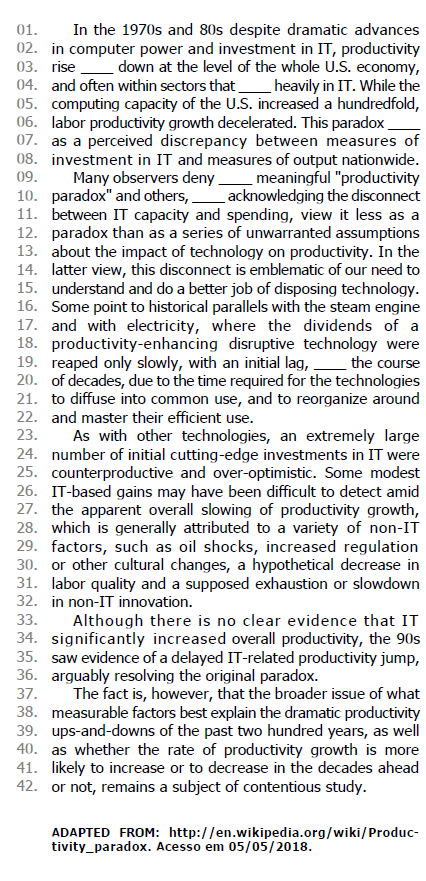
Which alternative presents a word or expression that can replace the word whether (l. 40) without changing the literal meaning of the sentence?
Select the alternative with the word that means the OPPOSITE of unwarranted (l. 12).
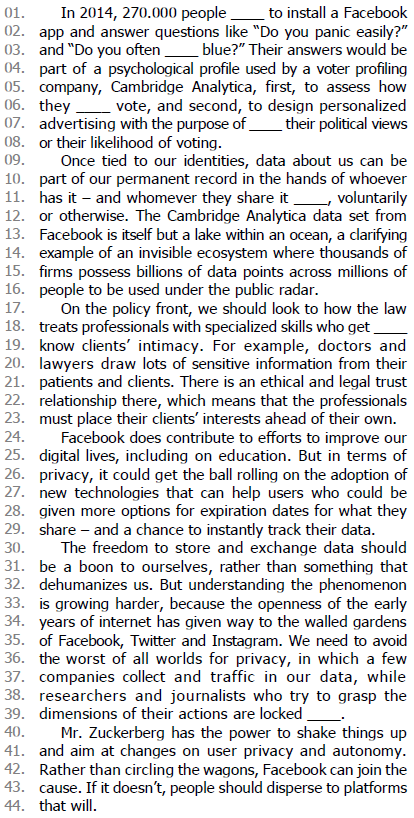
Considere as seguintes afirmações em relação ao texto.
I - blue (l. 03) significa, no texto, inseguro.
II - A expressão On the policy front (l. 17) refere-se às punições legais já aplicadas às questões de segurança na internet.
III - A expressão a boon to ourselves (l. 31) tem conotação positiva em relação à liberdade do uso de dados.
Quais estão corretas?
Assinale a alternativa que apresenta reescrita do segmento Mr. Zuckerberg has the power to shake things up and aim at changes (l. 40-41) que não acarreta alteração do sentido literal.
Selecione a alternativa em que todos os termos são formados pelo mesmo processo de formação de palavras.
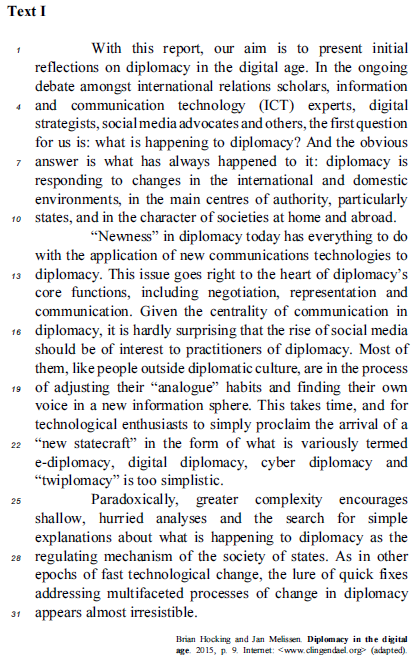
Decide whether the following statements are right (C) or wrong (E) according to text I.
The text lists three different kinds of change which affect diplomacy: those originated in international and domestic scenarios; those coming from the main centres of authority; and the ones which are related to societal transformations.
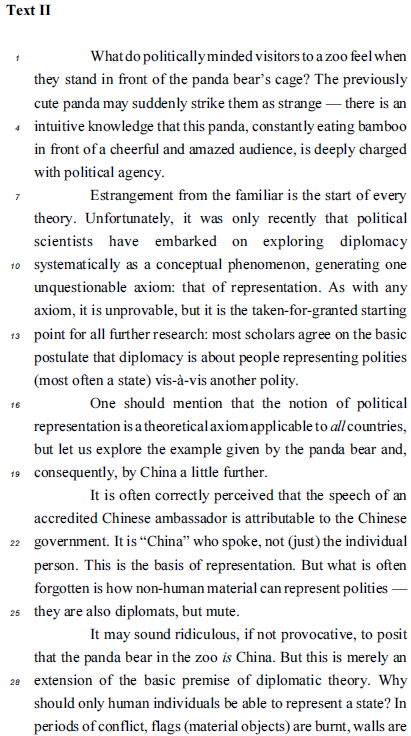
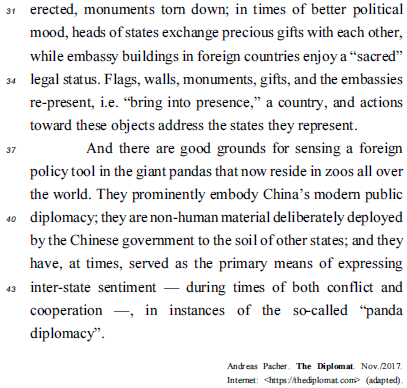
Decide whether the following statements are right (C) or wrong (E) according to text II.
As used in the text, the word “posit” (L.26) is synonymous with ignore.
Decide whether the following statements are right (C) or wrong (E) according to text II.
Because the word “deployed” (L.40) can be related to the meaning of putting troops or weapons in a position ready to be used, in the text it reinforces the idea that panda bears have acquired political and strategic significance.

Considering the grammatical and semantic aspects of text IV, decide whether the following items are right (C) or wrong (E).
According to the text, automated trading and other new technologies have made financial economics hegemonic among traders as a tool to interpret the gyrations of the financial market.
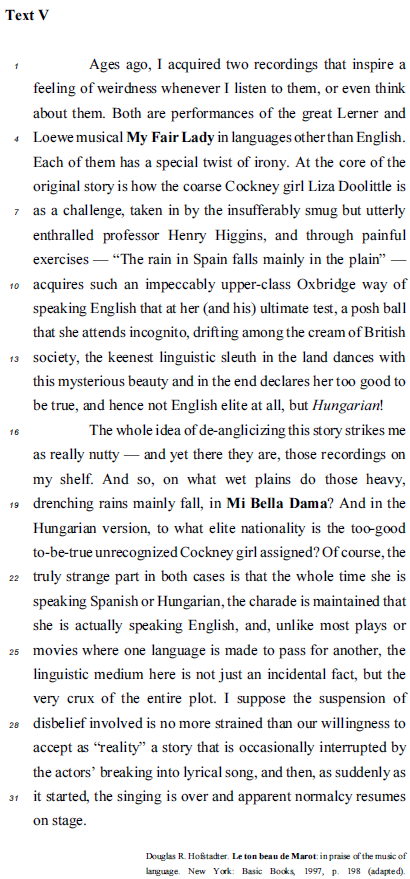
In text V, without altering the general meaning of the sentence, “enthralled” (L.8) could be replaced by (mark right — C — or wrong — E)
colorful.
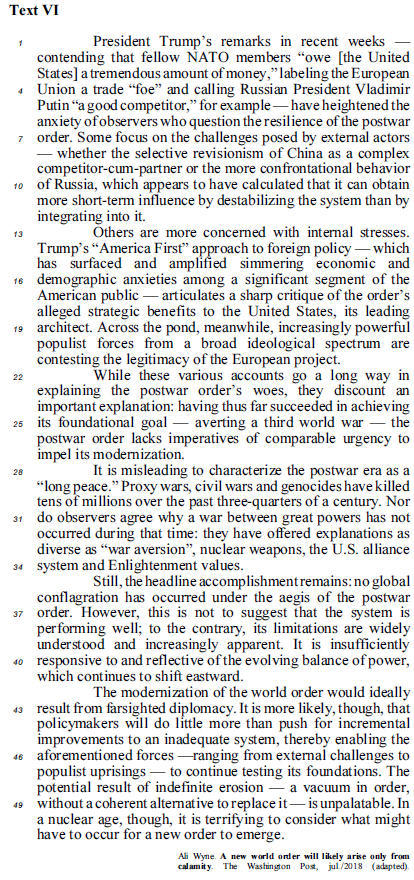
Considering the grammatical and semantic aspects of text VI, decide whether the following items are right (C) or wrong (E).
The phrase “obtain more” (L. 10 and 11) could be correctly replaced by accrue, without altering the meaning of the passage.
Considering the grammatical and semantic aspects of text VI, decide whether the following items are right (C) or wrong (E).
The word “simmering” (L.15) could be replaced by vocal without altering the general meaning of the passage.
The following is an example of word formation by verb to adjective conversion: