Judge the following item according to the ideas of the previous text and its linguistic aspects.
The fragment “prevent them from using" (R. 4 and 5) can be correctly replaced with prevent them to use.

Based on the ideas and linguistic aspects of the text above, judge the item below.
The sentence: “For some people, it is acquired as a first language" (R.15) can be correctly rewritten as For some people, it has acquired as a first language.
Based on the ideas and linguistic aspects of the text above, judge the item below.
It can be inferred from the text that some students of English resent it because of the negative feelings that colonialism inspires.
Judge the following item according to the ideas of the previous text and its linguistic aspects.
According to the text, the source of motivation is found inside a person.

Judge the following item, concerning the vocabulary used in text 5A7-I.
The word “undisputed" (R.30) may be replaced by unquestioned, without altering the meaning of the sentence.
Based on the ideas and linguistic aspects of the text above, judge the item below.
The word “economic", in “economic inequality" (R.24), could be replaced by economical, without changing the meaning of the text.

Considering the grammatical and semantic aspects of text V, decide whether the following items are right (C) or wrong (E).
The word “enjoined" (l.27) cannot be replaced by endorsed in this particular context.

Considering the ideas and the vocabulary of text II, decide whether the statements below are right (C) or wrong (E).
After all stages of the Civil and Diplomatic Service entrance exams, the number of candidates admitted was around 20.
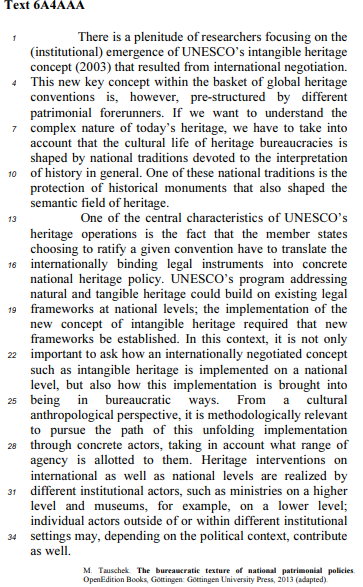
Considering the text 6A4AAA, judge the following item.
The Portuguese word imaterial is a suitable translation for the word “intangible" (ℓ.2) in the text.

In the text CB3A1AAA,