Um deputado escreveu para um colega:“Não adianta comunicar-lhe que esse projeto me trouxe muito sofrimento, porque certamente você também teve os seus... mas, pelo menos, você passa a ter ideia das dificuldades de nossa atividade”.
Esse segmento alude a um problema da língua escrita em relação à comunicação, que consiste no fato de:
Assinale a opção que apresenta a frase em que a locução adjetiva sublinhada foi corretamente substituída.
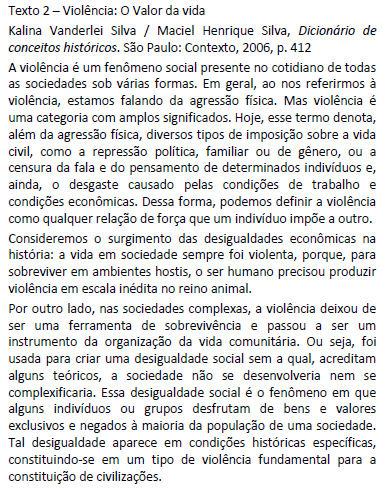
“Hoje, esse termo denota, além da agressão física, diversos tipos de imposição sobre a vida civil, como a repressão política, familiar ou de gênero, ou a censura da fala e do pensamento de determinados indivíduos e, ainda, o desgaste causado pelas condições de trabalho e condições econômicas”. Sobre os componentes desse segmento do texto 2, é correto afirmar que:

Ao escrever um texto, o autor enfrenta várias dificuldades. Uma delas é evitar a repetição de palavras e um dos meios para isso é substituir uma palavra de valor específico por outra de conteúdo geral, como no exemplo a seguir.
O sargento foi atropelado; depois de alguns minutos, chegou uma ambulância que levou o militar para o hospital.
Assinale os vocábulos abaixo que mostram, respectivamente, esse mesmo tipo de relação:

O texto 1 fala de uma adolescente vulnerável; o adjetivo vulnerável significa “sujeito a ser atacado" (Houaiss, 1961).
O adjetivo abaixo, formado com o mesmo sufixo, que tem seu valor semântico indicado corretamente é:
Texto – A eficácia das palavras certas
Havia um cego sentado numa calçada em Paris. A seus pés, um
boné e um cartaz em madeira escrito com giz branco gritava:
"Por favor, ajude-me. Sou cego". Um publicitário da área de
criação, que passava em frente a ele, parou e viu umas poucas
moedas no boné. Sem pedir licença, pegou o cartaz e com o giz
escreveu outro conceito. Colocou o pedaço de madeira aos pés
do cego e foi embora.
Ao cair da tarde, o publicitário voltou a passar em frente ao cego
que pedia esmola. Seu boné, agora, estava cheio de notas e
moedas. O cego reconheceu as pegadas do publicitário e
perguntou se havia sido ele quem reescrevera o cartaz,
sobretudo querendo saber o que ele havia escrito.
O publicitário respondeu: "Nada que não esteja de acordo com o
conceito original, mas com outras palavras". E, sorrindo,
continuou o seu caminho. O cego nunca soube o que estava
escrito, mas seu novo cartaz dizia: "Hoje é primavera em Paris e
eu não posso vê-la". (Produção de Texto, Maria Luíza M. Abaurre
e Maria Bernadete M. Abaurre)
A polissemia – possibilidade de uma palavra ter mais de um
sentido – está presente em todas as frases abaixo, EXCETO em:


Text II discusses the implications of blockchain for the accounting profession. Based on the arguments presented, analyse the following statements:
I. New technologies have affected CPA's work but not its relevance.
II. Blockchain technology will allow CPAs to shift their attention to other areas.
III. Accounting professionals should not waste time trying to understand new technologies.
Choose the correct answer:


READ TEXT II AND ANSWER QUESTIONS 16 TO 20:
TEXT II
The backlash against big data
[…]
Big data refers to the idea that society can do things with a large
body of data that weren't possible when working with smaller
amounts. The term was originally applied a decade ago to
massive datasets from astrophysics, genomics and internet
search engines, and to machine-learning systems (for voicerecognition
and translation, for example) that work
well only when given lots of data to chew on. Now it refers to the
application of data-analysis and statistics in new areas, from
retailing to human resources. The backlash began in mid-March,
prompted by an article in Science by David Lazer and others at
Harvard and Northeastern University. It showed that a big-data
poster-child—Google Flu Trends, a 2009 project which identified
flu outbreaks from search queries alone—had overestimated the
number of cases for four years running, compared with reported
data from the Centres for Disease Control (CDC). This led to a
wider attack on the idea of big data.
The criticisms fall into three areas that are not intrinsic to big
data per se, but endemic to data analysis, and have some merit.
First, there are biases inherent to data that must not be ignored.
That is undeniably the case. Second, some proponents of big data
have claimed that theory (ie, generalisable models about how the
world works) is obsolete. In fact, subject-area knowledge remains
necessary even when dealing with large data sets. Third, the risk
of spurious correlations—associations that are statistically robust
but happen only by chance—increases with more data. Although
there are new statistical techniques to identify and banish
spurious correlations, such as running many tests against subsets
of the data, this will always be a problem.
There is some merit to the naysayers' case, in other words. But
these criticisms do not mean that big-data analysis has no merit
whatsoever. Even the Harvard researchers who decried big data
"hubris" admitted in Science that melding Google Flu Trends
analysis with CDC's data improved the overall forecast—showing
that big data can in fact be a useful tool. And research published
in PLOS Computational Biology on April 17th shows it is possible
to estimate the prevalence of the flu based on visits to Wikipedia
articles related to the illness. Behind the big data backlash is the
classic hype cycle, in which a technology's early proponents make
overly grandiose claims, people sling arrows when those
promises fall flat, but the technology eventually transforms the
world, though not necessarily in ways the pundits expected. It
happened with the web, and television, radio, motion pictures
and the telegraph before it. Now it is simply big data's turn to
face the grumblers.
(From http://www.economist.com/blogs/economist explains/201
4/04/economist-explains-10)
READ TEXT I AND ANSWER QUESTIONS 11 TO 15
TEXT I
Will computers ever truly understand what we're saying?
Date: January 11, 2016
Source University of California - Berkeley
Summary:
If you think computers are quickly approaching true human
communication, think again. Computers like Siri often get
confused because they judge meaning by looking at a word's
statistical regularity. This is unlike humans, for whom context is
more important than the word or signal, according to a
researcher who invented a communication game allowing only
nonverbal cues, and used it to pinpoint regions of the brain where
mutual understanding takes place.
From Apple's Siri to Honda's robot Asimo, machines seem to be
getting better and better at communicating with humans. But
some neuroscientists caution that today's computers will never
truly understand what we're saying because they do not take into
account the context of a conversation the way people do.
Specifically, say University of California, Berkeley, postdoctoral
fellow Arjen Stolk and his Dutch colleagues, machines don't
develop a shared understanding of the people, place and
situation - often including a long social history - that is key to
human communication. Without such common ground, a
computer cannot help but be confused.
"People tend to think of communication as an exchange of
linguistic signs or gestures, forgetting that much of
communication is about the social context, about who you are
communicating with," Stolk said.
The word "bank," for example, would be interpreted one way if
you're holding a credit card but a different way if you're holding a
fishing pole. Without context, making a "V" with two fingers
could mean victory, the number two, or "these are the two
fingers I broke."
"All these subtleties are quite crucial to understanding one
another," Stolk said, perhaps more so than the words and signals
that computers and many neuroscientists focus on as the key to
communication. "In fact, we can understand one another without
language, without words and signs that already have a shared
meaning."
(Adapted from http://www.sciencedaily.com/releases/2016/01/1
60111135231.htm)
READ TEXT II AND ANSWER THE QUESTION.


READ TEXT II AND ANSWER QUESTIONS 21 TO 25:
TEXT II
The backlash against big data
[…]
Big data refers to the idea that society can do things with a large
body of data that weren't possible when working with smaller
amounts. The term was originally applied a decade ago to
massive datasets from astrophysics, genomics and internet
search engines, and to machine-learning systems (for voicerecognition
and translation, for example) that work
well only when given lots of data to chew on. Now it refers to the
application of data-analysis and statistics in new areas, from
retailing to human resources. The backlash began in mid-March,
prompted by an article in Science by David Lazer and others at
Harvard and Northeastern University. It showed that a big-data
poster-child—Google Flu Trends, a 2009 project which identified
flu outbreaks from search queries alone—had overestimated the
number of cases for four years running, compared with reported
data from the Centres for Disease Control (CDC). This led to a
wider attack on the idea of big data.
The criticisms fall into three areas that are not intrinsic to big
data per se, but endemic to data analysis, and have some merit.
First, there are biases inherent to data that must not be ignored.
That is undeniably the case. Second, some proponents of big data
have claimed that theory (ie, generalisable models about how the
world works) is obsolete. In fact, subject-area knowledge remains
necessary even when dealing with large data sets. Third, the risk
of spurious correlations—associations that are statistically robust
but happen only by chance—increases with more data. Although
there are new statistical techniques to identify and banish
spurious correlations, such as running many tests against subsets
of the data, this will always be a problem.
There is some merit to the naysayers' case, in other words. But
these criticisms do not mean that big-data analysis has no merit
whatsoever. Even the Harvard researchers who decried big data
"hubris" admitted in Science that melding Google Flu Trends
analysis with CDC's data improved the overall forecast—showing
that big data can in fact be a useful tool. And research published
in PLOS Computational Biology on April 17th shows it is possible
to estimate the prevalence of the flu based on visits to Wikipedia
articles related to the illness. Behind the big data backlash is the
classic hype cycle, in which a technology's early proponents make
overly grandiose claims, people sling arrows when those
promises fall flat, but the technology eventually transforms the
world, though not necessarily in ways the pundits expected. It
happened with the web, and television, radio, motion pictures
and the telegraph before it. Now it is simply big data's turn to
face the grumblers.
(From http://www.economist.com/blogs/economist explains/201
4/04/economist-explains-10)

Para viajar aos Estados Unidos, Lucas trocou x euros por dólares
americanos, a uma razão de sete dólares para cada seis euros.
Após gastar 1000 dólares nos Estados Unidos, Lucas verificou que
ainda tinha x/2
dólares americanos.
O valor de x é:
Miguel tem um terreno retangular com 30 m de comprimento e 25 m de largura, e pretende cercá-lo com 4 voltas de arame farpado. Para isso, ele comprou um rolo de arame farpado com 500 m de arame.
Após realizado o trabalho, Miguel verificou que
Manoel possui tintas de 5 cores diferentes e deve pintar a bandeira abaixo de forma que:
• cada região será pintada com uma única cor.
• duas regiões vizinhas não podem ter a mesma cor.

O número de maneiras diferentes que Manoel pode pintar essa bandeira é
Uma sentença logicamente equivalente à sentença “Se Pedro é torcedor da Chapecoense, então ele nasceu em Chapecó" é:
Determinado operador, pessoa natural que realizou o tratamento de dados pessoais em nome de controlador, pessoa jurídica de direito público, em razão do exercício de atividade de tratamento de dados pessoais, causou dano patrimonial e moral a Caio, tendo sido comprovada, judicialmente, a violação à legislação de proteção de dados pessoais.
A partir da legislação em vigor, é correto afirmar que:

Um dos fatores que contribuiu para o crescimento do PIB foi a
A Lei da Terceirização, foi sancionada pelo presidente Michel Temer, em 31 de março. Essa lei dispõe que:
I. A terceirização poderá ser aplicada a qualquer atividade da empresa, tanto atividade-meio como atividade-fim.
II. O tempo de duração do trabalho temporário não deve ultrapassar três meses ou 90 dias.
III. Após o término do contrato, o trabalhador temporário só poderá prestar novamente o mesmo tipo de serviço à empresa após esperar três meses.
Está correto somente o que se afirma APENAS em
No dia 1 de junho de 2017, jornais de várias partes do mundo deram a manchete:
Trump anuncia retirada dos EUA do Acordo de Paris sobre o clima
A justificativa dada por Trump para a saída do Acordo de París foi que
Recentemente o empresário Elon Musk comprou a rede social Twitter, uma das plataformas de comunicação mais acessadas no planeta.
Uma das primeiras ações do novo proprietário foi a